After six months of unanswered emails, worrying lack of news and uncertainty, we had admittedly began losing hope regarding any positive results from our work in Palmera, our first project of this trip. We had sent countless emails to the Costa Rican Humanitarian Foundation asking for news from the Cabecar Indigenous Reserve, and for the report we had written for them, so we could perhaps attract investment, tourism and volunteers to continue the process that the Foundation had started and we had enhanced during our nearly two months living with a local family. We had found a magnificent community, rich in resources and culture, but lacking in infrastructure. A very promising land where a terribly apathetic mindset obscured the vision of the future for the youth, despite their eagerness and commitment to education.
It was exactly with education, the bridge between preserving their ancestral history and bringing positive development to the community, where the key to the gate of the future lay for Palmera and the majority of its inhabitants. Although we focused our activities on strengthening the link between these two factors and improving local understanding of their importance, we hit a massive road block very early in the form of corruption.
The newly appointed principal of the high school had taken advantage of the seeds planted by his predecessor, now working a few hundred meters away as principal of the elementary school, and didn't take long to harvest the rewards. There was factual evidence that he was repeatedly using school funds for personal use, buying personal hygiene products, food and alcohol, as well as rather heavy accusations of drug use on school grounds and in the presence of students. In addition, the president of the board of education, otherwise known as the town drunk, had taken a liking to the methods of the new principal and soon became involved in these insidious activities. The most worrying result of these acts was the constant cancellation of classes, three or four times a week for lack of food in the school cafeteria, and the inability of the faculty to buy teaching materials. Teachers had to use their own money for such purchases.
The students displayed a flagrant mistrust in the educational system as was demonstrated by the lacklustre attendance, which was well under fifty percent. Many of the young boys would rather work with their fathers in the nearby plantations. The girls, many of whom were already mothers, could not afford to waste their precious time at a school that didn't provide a meal nor an education, and preferred to tend their domestic duties, as Cabecar tradition dictates.
Infuriated upon realizing this, and urged on by members of the community, teachers and students, we wrote a letter to the regional authorities and the local board of education, asking for an internal investigation, a new directive and a series of conditions in order to achieve transparency and a more efficient administration in the years to come.
The effects of the letter were immediate, although not as impactful as we had hoped. As news of a board meeting to assess the situation spread through the town, fierce tension invaded the faculty, the student body and the general population, as everyone began dividing between those who supported the principal and those who quietly disapproved. Fortunately, there was a third group: those who had taken a stand against the principal and the president of the board. Unfortunately, the group only consisted of our host family, the school cook, as the teachers who had initially inspired and incited us to take action, ultimately denied everything in fear of losing their jobs. The board meeting, which was dramatically similar to a court trial was hindered by the principal, who made sure it was scheduled during school hours so that the few students who were willing to take a stand against him would not attend. Much to our dismay, Leo, the father of our family forbid us from attending, fearing an angry reaction from the two characters involved, who had proven to be rather unpredictable.
As we had expected, without lack of support for our cause, the principal asserted his position at the board meeting, gaining support from the board members, whom he and the president had appointed. The appointees were illiterate, an unlawful situation, as we came to find out.
Our projects at the school became severely hampered on account of our actions, as we were no longer welcomed at the school. Some of the teachers were certainly reluctant to be seen speaking to us, so we spent most of our time with our family.
What had begun as an emotive and devoted campaign, ended quietly as we left Palmera without any visible results to our actions. Eventually, once we had the time and resources, we extended our letter to the Ministry of Education, but only received an acknowledgement of receipt from them. The past few months we had often wondered, albeit hopelessly, what had been of the situation in Palmera, and whether Leo, his family or anyone in town had fed the fire that we had ignited.
Surprisingly, yesterday we received a great piece of news from the Costa Rican Humanitarian Foundation.
The principal of the school has been sanctioned, and is being very carefully watched by the Ministry of Education. They are assessing the situation and may fire him in the coming weeks. From now on, the principal is not allowed to cancel classes, nor does he have access to funds, as it goes directly from the Ministry to the suppliers. The members of the board of education are now named democratically by the people and the student government has been given additional support and power. The people of Palmera are satisfied with these changes, which they directly attribute to the document we drafted in early November.
We left Palmera more than half a year ago, with an amazing experience to remember for the rest of our lives, but disappointed at being unable to make a lasting impact. Over the past few months, a mountain of disappointment had began to build on the foundations created during our time in Palmera as we poured our hearts and souls into several projects along the way but failed to see the end results. Thus, as you can imagine, it is extraordinarily rewarding and fulfilling to receive these news.
We can now see more clearly the importance of embroidering experiences, even the most marvelous ones, with actions which will last beyond memory.
"They are small things. They don't bring an end to poverty or lift us out of underdevelopment, they don't enforce social responsibility in means of production and exchange, and they don't expropriate Ali Baba's caves. But perhaps they set in motion the joy of doing, and translate it into specific acts. And, when all is said and done, acting on reality and changing it, although just a little bit, is the only way to prove that reality is transformable." - Eduardo Galeano (Uruguayan journalist and writer)
You can find the report we wrote to the Costa Rican Humanitarian Foundation and the letter to the Ministry of Education in our new 'Documents' section.
Showing posts with label indigenous. Show all posts
Showing posts with label indigenous. Show all posts
Tuesday, June 11, 2013

Tuesday, May 7, 2013
Soloy: Part 1
I beg you forgive me for the late deliveries of this
blog. Although it would be ideal, and fairest to you readers, to update our
experiences in a timelier manner; time is the most ephemeral of things, and it
is extremely difficult to keep up with it. As time vanishes, thus escape my
memories of events, from the most transcendental to the most banal. We promise
to keep up with our stories, if you promise to transport yourself to the time at
which they happened. The line at which our experiences develop is much faster
than my pen.

 Returning o dry land; in February, we traveled to Soloy for our next project. There, the summer threatens to dry up the mightiest river or the most resilient crop, and the wind never dwindles. The gusts of wild wind, or 'breeze', as the locals call it, steal anything that isn't tied down. Sadly, despite an abundance of real wind, many members of the community do lack the aforementioned metaphorical wind. Although to a lesser extent than in Palmera. There are a number of individuals in the community who are properly organized and informed, who work hard to achieve what they want. However, apathy and abandon reign as the leading philosophy for the majority of the population, who aspire to little more than brief moments of material satisfaction without regard for long term consequences. Ironically, it doesn't land too far from the description of more 'advanced' communities in 'developed' countries.
It is really sad to
witness natural beauty being ruined by pollution, unity by violence and the
future by greed, ignorance or addiction. But the thing that saddens us the most
is witnessing a great potential walking head down, unarmed, hidden in the
shadow of these problems.
As our voyage progresses, and thus our experience and education – unlimited
and insufficient and unlimitedly insufficient – I realize that there are no
insurmountable problems; only unwilling people. Having said that, the most
positive aspect of our trip has been the people we have encountered. It's a
pity, therefore, that the answer is the same to the opposite question.
So we found ourselves in Soloy, wedged between the two landmarks that intersect Panama. Symbols of the prowess of man and nature alike, the Interamerican Highway and the Continental Divide proudly form the spine of the country. In the Western section of the Divide, growing softly from the flat
lands resting at its sides, the Serranía de Tabasará is dominantly poised; an
acutely eroded arch in which peaks were formed by volcanic intrusions, of which,
Volcan Barú, the nation's tallest summit, oversees the slow industry developing
around its fertile soil. Its skirts, abounding with meandering creeks, commanding
rivers, and a nuanced spectacle of shades of evergreen jungle full of intricate
vines and exotic animals, have long shared their secrets and protective mantle
with the Ngäbe Indians.
 Today, like so many other indigenous populations throughout the world,
the Ngäbes fight an everyday battle against the overflowing currents of
modernity and the industrial exploitation of natural resources. As fortune has
it, the Ngäbes are settled on the nation's richest soil, a magnet for foreign
mining and energy companies as well as government leaders of questionable
principles.
Today, like so many other indigenous populations throughout the world,
the Ngäbes fight an everyday battle against the overflowing currents of
modernity and the industrial exploitation of natural resources. As fortune has
it, the Ngäbes are settled on the nation's richest soil, a magnet for foreign
mining and energy companies as well as government leaders of questionable
principles.
Soloy is one of the main towns in the Comarca; not much more than a
strip of pavement with houses lined up at its edges, like buttons on a shirt. Located
at the end of the main road plunging from the Interamerican Highway into the
Comarca, Soloy provides a meeting point for merchants, artisans and farmers. The
center of town, which has two multipurpose stores and a restaurant is also a
transfer point for the transportation system, as the public bus stops there and
taxis, cars and horses transit the area taking people – and food – to and from
communities inaccessible by bus.

We lived in a particular section of Soloy called Boca Miel, about 2 km
away from the center of town, where the pavement ends and dirt paths ramify in every
direction. The Ngäbe Buglé Comarca is divided into seven districts. Soloy is
one of eight corregimientos (a country subdivision for administrative purposes;
in other, simpler words, a town) in the District of Besikö, located in the
south-west of the Comarca. The Comarca is populated by the Guaymi Indians, and
receives its name after its two linguistic subgroups, the Ngäbe, and the Buglé,
whose languages are mutually unintelligible. Most of the adults speak their
native language regularly, as well as Spanish, albeit rather limited in some
cases. However, the youth pose a cause for concern, for many do not know more
than a few basic Ngäbere words. Worryingly, their Spanish is often a carnage of
the already mutilated Spanish spoken by their elders.
 The comarca hosts approximately
160,000 people in an area of roughly 7,000 km2. Soloy is home to
some 1,500 people, most of which live in terrains with a few structures ranging
from huts to concrete houses and about half a hectare of arable land. The
houses vary in form and material, with concrete, zinc, bamboo and other timber
used interchangeably. Zinc roofs, often deemed in Western society as a sign of
underdeveloped neighborhoods, were proliferated in the Comarca as a substitute
for traditional palm roofs.
The comarca hosts approximately
160,000 people in an area of roughly 7,000 km2. Soloy is home to
some 1,500 people, most of which live in terrains with a few structures ranging
from huts to concrete houses and about half a hectare of arable land. The
houses vary in form and material, with concrete, zinc, bamboo and other timber
used interchangeably. Zinc roofs, often deemed in Western society as a sign of
underdeveloped neighborhoods, were proliferated in the Comarca as a substitute
for traditional palm roofs.
More durable, stable and expensive, zinc became a
luxury item when it was first introduced a couple of decades ago. An
irrevocable trait of human nature, envy, soon converted this developing world
architectural icon into a must-have throughout Soloy and other neighboring
towns.
 Although most households have stable concrete structures where the
family sleeps and stores their valuables, many still have traditional
"ranchos" in their properties, under which they have hammocks and
usually sleep there on warm summer nights. Since there are only two seasons in
Soloy - dry and rainy – the hammocks out in the open air are still the
preferential sleeping arrangement for the majority, especially nostalgic adults
who see their childhood lifestyle quickly fading away.
Although most households have stable concrete structures where the
family sleeps and stores their valuables, many still have traditional
"ranchos" in their properties, under which they have hammocks and
usually sleep there on warm summer nights. Since there are only two seasons in
Soloy - dry and rainy – the hammocks out in the open air are still the
preferential sleeping arrangement for the majority, especially nostalgic adults
who see their childhood lifestyle quickly fading away.
There are two sections of the town which are distinct from all the others. The center of town, and Barriada 2000. The latter is an infamous aglomeration of huts, people and trash which constantly emanates a profane smell of burnt plastic. An accelerated image of the development of the area, the Barriada was created in response to the establishment of the new school in Soloy at the turn of the century. As the news of the educational center reached the more remote, isolated villages of the Comarca, an influx of families arrived in Soloy.
 Ready to sacrifice whatever commodities they had at their permanent
residences, they built temporary huts in a space provided by the municipality
so they could live during the school year. However, temporary plans gave way to
permanent relocation, and soon, an entire hillside, once washed by a crystaline
creek, fertile and brimful with handsomely robust mango and orange trees,
became a ghetto where somber shacks are separated by still streams of black,
garbage infested mud, and dirt paths occupied by curious, energetic children
weary of an insipid, mundane life confined to poverty.
Ready to sacrifice whatever commodities they had at their permanent
residences, they built temporary huts in a space provided by the municipality
so they could live during the school year. However, temporary plans gave way to
permanent relocation, and soon, an entire hillside, once washed by a crystaline
creek, fertile and brimful with handsomely robust mango and orange trees,
became a ghetto where somber shacks are separated by still streams of black,
garbage infested mud, and dirt paths occupied by curious, energetic children
weary of an insipid, mundane life confined to poverty.
Mocked and degraded by their neighbors and forgotten by local
politicians, the Barriada 2000 is obviously a source of shame, and to some
extent, disgust to the rest of the community. Unresourceful and abandoned, the
people who dwell there have little to do in the face of the structural disaster
in which they live. Initiatives have been proposed and outside organizations
have declared their intention to improve their conditions, – beginning with latrines
– but sadly, the rythm of affairs, already slow in this section of the world,
is nearly stagnant.

In many aspects, Soloy is very different from other Indigenous Communities we have visited. The road and the proximity of the houses attract businesses and tourism, opening a large gate to the outside world. This has a noticeable effect on the people, who are distinctly less timid than in more secluded places. The first contact we made with the Ngäbes was in the bus station in David, minutes before departing to Soloy on a yellow school bus, one of many specimens sent to Panama after their retirement in the US.
There, I
found a scene worthy of a commercial. Three middle-aged Ngäbe women sitting on
a bench, jauntily drinking soft drinks while waiting for the bus. They were
naturally dark, with long, radiant black hair flowing casually in the wind and
dipping behind their shoulders, playfully appearing over the colorful tones of
their traditional dresses, which covered their bodies down to their
ankles.
I couldn't resist the urge to take a photo, thinking what a glorious
photograph this would have been a few decades ago, yet ready to hear a nearly
inaudible "no" for an answer, or a shy affirmation which would result
in them turning their faces the moment I snapped the photo, as it so often
happened elsewhere. My bold request caused them to giggle like young teenagers,
which prompted me to respectfully back away. However, as I turned my back, they
all said "sí, por favor!" At that moment, once again deceived by the
wrong idea of what we would encounter in the mountains, - this time caused by
the official website of a local NGO which hadn't been altered in more than ten
years - I believed I had captured a photographic jewel.
After spending one day in Soloy, I came to realize just how mundane that image was...

Thursday, January 10, 2013
Boruca - New Year with the Devils

On the last day of 2012 we boarded yet another bus in our long list of ill-fitting buses and headed to Boruca, the main settlement within the Boruca Indigenous Reserve. Do not be
mislead by the use of ill-fitting, for, despite their leisurely pace, the
quality of the buses is more than sufficient. The problem at hand is that the
seats are designed bearing in mind the average height of Costa Ricans, which,
for men, is nearly 20 cm less than the stature of yours truly. As you can
imagine, negotiating bumpy roads with barely a few inches of meager legroom and
a vacuum behind your head which lets your neck wobble like a boxing ball is not
a pleasant experience.
 After a two hour journey
during which we constantly had to ask our neighbors where we had to get off, the
driver informed us that we had reached the entrance to Boruca. Unbeknownst to
us, we were twelve kilometers of devastatingly steep, arid dirt away from the
actual town.
After a two hour journey
during which we constantly had to ask our neighbors where we had to get off, the
driver informed us that we had reached the entrance to Boruca. Unbeknownst to
us, we were twelve kilometers of devastatingly steep, arid dirt away from the
actual town. In hindsight, we regarded
the sheer path ahead of us and the gleaming noon sun with too much disdain. We nearly
paid for our foolishness and disrespect when, after half an hour, unable to
find a shade to rest, we began questioning if we had made the right decision.
Luckily, a kind family coerced us into riding in the back of their pick-up
truck and turned what would have been a painstaking five hour hike into a 30
minute rollercoaster ride through the jarring unpaved hills.
In hindsight, we regarded
the sheer path ahead of us and the gleaming noon sun with too much disdain. We nearly
paid for our foolishness and disrespect when, after half an hour, unable to
find a shade to rest, we began questioning if we had made the right decision.
Luckily, a kind family coerced us into riding in the back of their pick-up
truck and turned what would have been a painstaking five hour hike into a 30
minute rollercoaster ride through the jarring unpaved hills.
Once in the town, we
installed our camping tent and proceeded to discover what the town had to
offer, including a majestic waterfall and an ancient blend of dancing and
bull-fighting.

 Submerged in the Talamanca
Mountains and encircled by the scenic valley of the Rio Grande de Terraba, this
secluded site was once part of a vast territory. Before the arrival of the Spanish Empire in the 16th century, the Coto, Turruca, Borucac, Quepos and the Abubaes feuded over the region of the Pacific coast of Costa Rica, from present day Quepos to the frontier with Panama. Today, the Boruca are a composite group of nearly 2500 people, formed by the descendants of the dispersed tribes, who are said to have survived the invasion thanks to the aid of natural spirits.
Submerged in the Talamanca
Mountains and encircled by the scenic valley of the Rio Grande de Terraba, this
secluded site was once part of a vast territory. Before the arrival of the Spanish Empire in the 16th century, the Coto, Turruca, Borucac, Quepos and the Abubaes feuded over the region of the Pacific coast of Costa Rica, from present day Quepos to the frontier with Panama. Today, the Boruca are a composite group of nearly 2500 people, formed by the descendants of the dispersed tribes, who are said to have survived the invasion thanks to the aid of natural spirits. Despite crowning a
captivating mountain range and proudly boasting a phenomenally picturesque
cultural tradition, Boruca is dreadfully indistinct from any ordinary Costa
Rican town. Granted, this characteristic has positive and negative aspects.
Despite crowning a
captivating mountain range and proudly boasting a phenomenally picturesque
cultural tradition, Boruca is dreadfully indistinct from any ordinary Costa
Rican town. Granted, this characteristic has positive and negative aspects. 
The first indigenous reserve to receive
government aide, Boruca has been endowed with electricity, well equipped
schools and a centralized structure for a quarter century. The view, otherwise rural
and organic; adorned with banana-leaf-roofed ranchos, is abhorrently obstructed with cables, a massive cross,
satellite dishes and a devastating amount of garbage.
Tourists, often deceived
into visiting insipid cultural sites, may consider the town fairly
unexceptional if they visit during any other time of the year. But, peculiarly coinciding
with the end of the Christian year, from the evening of December 30th
until the twilight of January 2nd, the Borucas celebrate the Fiesta de los Diablitos (Festival of the
Little Devils) in commemoration of their survival against the forces of Spanish
conquistadors. This ritual with a side of party and a pinch of brawl is
anything but dull. The festivity is a flaming showcase of their culture and
spirit.
 Minutes before midnight
on December 30th, the town’s elder summons all the diablitos – basically any male over 15
years old – to his house.
Minutes before midnight
on December 30th, the town’s elder summons all the diablitos – basically any male over 15
years old – to his house.
Once there, the diablitos commence parading the town
stopping at every house to drink chicha
(fermented corn liquor) and eat tamales.
The diablitos wear intricate hand-carved and painted balsa wood masks and
burlap sacks covered with jute and banana leaves. The procession is marked by
the relentless collisions against a bull – a few of the men take turns carrying
a heavy costume and bashing the diablitos– which represents the Spaniards.
The name ‘diablitos’, the
horned masks, and the fighting symbolize the shrewdness, guile, courage and
ardor that served them so well in resisting invading forces, while the sharing
of drinks and food is indicative of their undeniable hospitality, not only among
themselves, but with the few tourists who venture into the town to witness this
astonishing display.
The masks are the main
attraction and source of income throughout the year, when the diablitos drop
their costumes and work in the fields, in San Jose or manufacturing masks and
totems. However, during the festivity, it’s the evolving interaction with the
bull that draws the most attention, as the diablitos, increasingly inebriated
and aggressive, rampantly quarrel with the 40kg structure of the bull.
Adding to the uniquely
vibrant imagery of Boruca during these dates, each diablito proudly and
carefully carves and paints his own mask with colorful feathers, dramatic images of trees, flowers, animals
and of course, hostile, menacing horns. Each mask is exclusively
ornate, especially during the pinnacle of the feast, on January 2nd,
when approximately 100 locals dress up and taunt the bull until it eventually
gains ground and takes down all the diablitos.

Then, the bull runs away, but
the diablitos, inspired by the animal spirits that aided them centuries ago,
rise from the dead, hunt down the bull and toss it into a blistering fire as
they soar around the flames celebrating the victory. The revelry that ensues is
even more exhilarating than in the previous nights, as the citizens of Boruca
put on their best outfits and party well into the night.
 So far we’ve had the
chance to meet members of three different indigenous groups, while visiting two
reserves. Despite being branded with the name ‘indigenous’, each of these
groups is very different from the others, not only regarding cultural characteristics
such as language, art and organization of society, but also with respect to
progress and development – where they find themselves at this moment in
history.
So far we’ve had the
chance to meet members of three different indigenous groups, while visiting two
reserves. Despite being branded with the name ‘indigenous’, each of these
groups is very different from the others, not only regarding cultural characteristics
such as language, art and organization of society, but also with respect to
progress and development – where they find themselves at this moment in
history.  Their openness to the world outside their barriers, their knowledge of
world events, acceptance of tourism and external influences, as well as other
aspects beyond their endemic culture are shaping their societies in ways undeterminably
good or bad. Time will be the judge.
Their openness to the world outside their barriers, their knowledge of
world events, acceptance of tourism and external influences, as well as other
aspects beyond their endemic culture are shaping their societies in ways undeterminably
good or bad. Time will be the judge. These groups continue to
be called indigenous but the meaning and usage of this word has loosely
dissipated in modern times. The Merriam-Webster dictionary defines indigenous
as “having originated in and being produced, growing, or living naturally in a
particular region or environment”.
These groups continue to
be called indigenous but the meaning and usage of this word has loosely
dissipated in modern times. The Merriam-Webster dictionary defines indigenous
as “having originated in and being produced, growing, or living naturally in a
particular region or environment”.  As
for ‘indigenous peoples’, there is no universally accepted definition, but according
to Wikipedia, there are three elements used to describe the term: the voluntary
perpetuation of cultural distinctiveness, an experience of subjugation, marginalization
and dispossession, and self-identification. However, according to these two
definitions, most of the world’s population is indigenous. Surely, there
must be something more to the essence of the word.
As
for ‘indigenous peoples’, there is no universally accepted definition, but according
to Wikipedia, there are three elements used to describe the term: the voluntary
perpetuation of cultural distinctiveness, an experience of subjugation, marginalization
and dispossession, and self-identification. However, according to these two
definitions, most of the world’s population is indigenous. Surely, there
must be something more to the essence of the word. Colloquially, ‘indigenous’
is used to describe a close relationship with nature, respect for all things
living, separation from the modern urban society, and the upholding of ancient
traditions as core community values. Through the experiences of the last few
months we have come to the realization that perhaps ‘indigenous’ is no longer a
term to define a place of origin, but rather a way of living, a philosophy and
a sentiment.
Colloquially, ‘indigenous’
is used to describe a close relationship with nature, respect for all things
living, separation from the modern urban society, and the upholding of ancient
traditions as core community values. Through the experiences of the last few
months we have come to the realization that perhaps ‘indigenous’ is no longer a
term to define a place of origin, but rather a way of living, a philosophy and
a sentiment.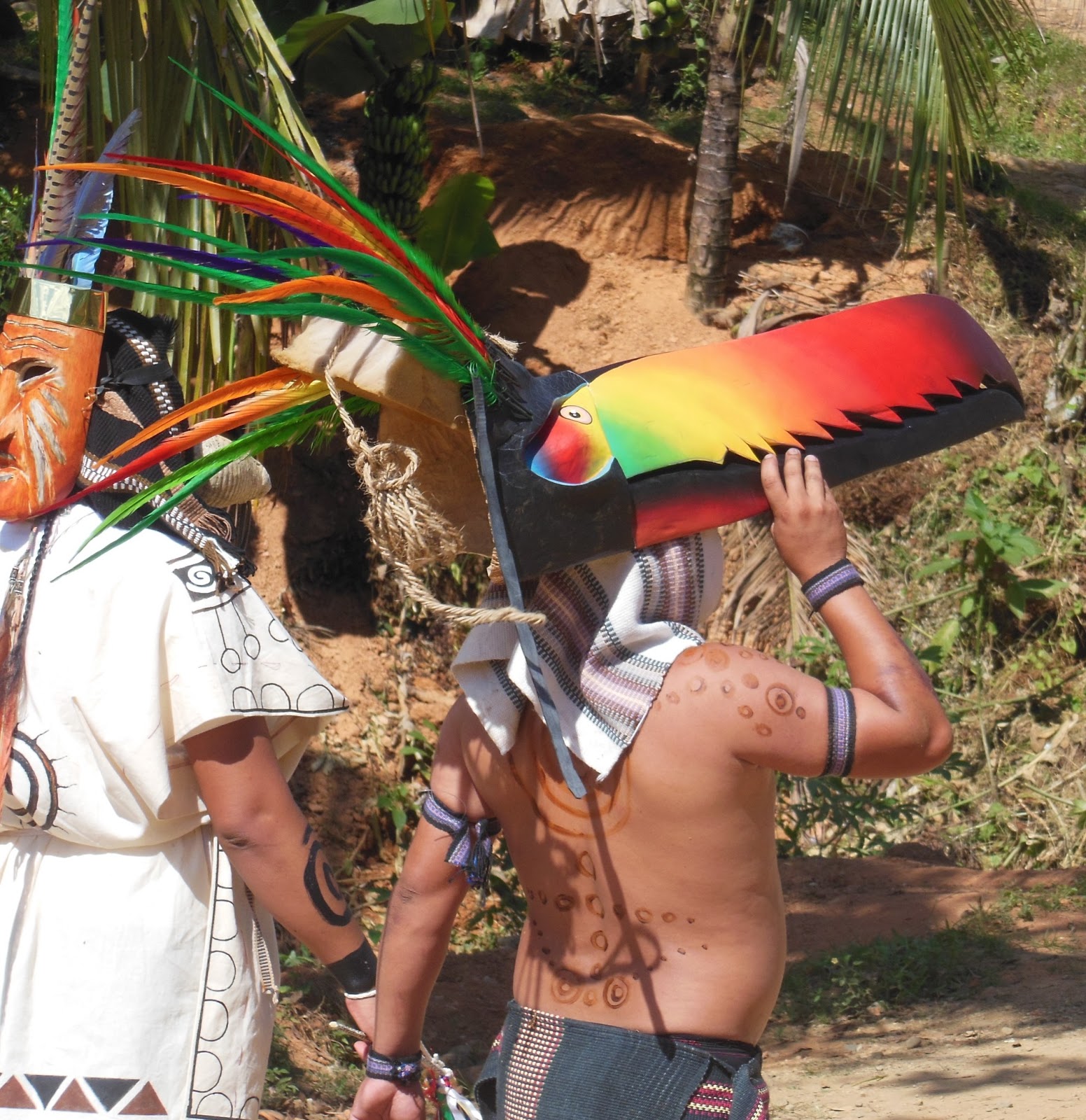 The indigenous people of Boruca, as well as many others throughout the world are in danger of extinction. ‘Being indigenous’ is not passed on genetically. It requires education, reason, sacrifice and determination.
 Thus, the inhabitants of Boruca will continue to be called indigenous because they live in the land that their ancestors fought and cared for, and have the physical traits of their parents; but must of them won’t be indigenous in regards to the colloquial understanding of the word – unless they consciously choose so.
 ‘Being indigenous’ is not about being different, about suffering from marginalization and racism, but about preserving the unique and valuable elements of their ancestry. We’ve met many ‘indigenous people’ who do not enjoy a traditional way of living, or who do not respect nature, just as there are many ‘non-indigenous people’ throughout the world who share the indigenous philosophy.
Progress will come not through imposing or opening the doors to the modern world, but by building a bridge through which education, information and respect can travel both ways.

Tuesday, December 4, 2012
Wektë bas ra: Projects and Daily Life in Palmera
We arrived in Palmera on October 21st with a plethora of objectives. Some were commissioned by the Humanitarian Foundation, whereas others were personal. Our primary instruction from them was to complete a report which would enhance their understanding of the community, their progress and their needs.

To do so, we carried out two workshops at the local high school. One was dedicated to their academic and professional futures, in hope of encouraging them to continue their education after graduation and fulfil their potential. The other consisted of a cultural exchange, hoping to emphasize the importance of their identity; helping them comprehend the significance of retaining their native culture. For many of the students, it is a sacrifice to attend school everyday. Many of the females are mothers and housewives, while the young men could be earning a living for their families at the plantations. Furthermore, the average student walks for an hour to get to school, and some have to walk for up to three hours, as they live in houses wildly scattered across the mountain. Thus, we were incensed when we discovered a grave and pertinent problem affecting the educational institutions. Casually conversing with teachers, locals and in our visits to the school, we found out that a couple of key functionaries of the educational institutions were malignantly involved in negligence and embezzlement, leaving the students without lunch on a daily basis and the teachers without equipment. Having ignited our fire within, we urged them to take action. On behalf of the community, we helped them draft a letter to the regional authorities, asking for an internal investigation, a new directive and a series of requisites in order to achieve transparency and a more efficient administration in the years to come.
 The foundation, who has been involved in numerous projects for the community, also collaborates closely with a group of artisan women. Envisioning increased visibility and documentation, we were asked to create a brief documentary on the intricate process of their craft; including pictures, videos and short biographies. However, we were disappointed by their lack of interest and cooperation when we summoned them to share their art. Sadly, the documentary will be undermined as a result. Similarly, the letter wasn´t signed by most of the people who initially endorsed it. What we initially thought to be fear of retribution may have turned out to be simply passivity or apathy. At the time of our departure, the powerful letter rested impotently in a dusty folder.
On a more positive note, we helped Leo, our host, write a proposal to build a lodge which will greatly improve the development and well being of the community. The Cabecar Cabin, as it will be named, will host tourists, students, researchers and will serve as a locale to impart technical courses. The foundation is now using this proposal to find the necessary funds to bring the project to life.
 Needless to say, our time in Palmera was a rich and fruitful adventure, and the perfect beginning to our journey. Not a single day went by without a new experience or lesson.
For a month and a half, we were graciously hosted by a most exceptional indigenous family led by Genni and Leonel. Humbly but joyously, they live with Marilin (8), their cute and mischievous daughter, and their hardworking and curious son Junior (14), who loves Iron Maiden and playing the guitar. Their home is also graced by the presence of Genni´s lovely and bright stepsister Karen (10), who is a best friend and sister to Marilin; and Genni´s youngest brother Julio (16), who decided to leave the city of Limon and moved to Palmera this August, where he enjoys the peaceful and healthy life of the mountain and learns from Leo to become a working man.
 In the mountain, away from electricity, the sun is the axis of time. There, daily life is ruled by the beaming star much more significantly than in the smog forests of concrete. Work, travel and any outdoor activity is determined by its light, and must first consult with its appearance. In a rare day at the reserve, we witnessed a momentous event in the advancement of the community. Curiously, it further increased their dependence on the sun. In the largest gathering we experienced, representatives of 35 households bought a small solar panel from a local development NGO. The panel gathers enough energy to power three light bulbs and charge a cellphone, but it is far from producing enough electricity to sustain all the needs of a modern home. Although lacking electricity has many repercussions, most of them are simple annoyances.
At dawn, the persistent rooster would succeed after three hours of irritating attempts of waking us from our slumber. If rain was pouring, we stayed at home and wrote in our journals or drafted projects. We would read, relax in the hammock on the porch, play with the kids or philosophized as we contemplated the waterfalls cascading over the roof. Regularly, the rain would overflow the source of water used in the home - a small basin in the ravine a couple hundred meters into the forest. If so, we would accompany one of hosts, following the hose from the house through the scenic and wild creek.
 When the weather permitted it, we would walk to the school or hike around the mountain, machete in hand. Also, we would help with domestic duties, such as cutting down trees, chopping them up for wood and carrying them back to the house; and collecting leaves and flowers to make paint, as well as picking oranges, lemons, cacao and other local fruits and vegetables. A week before the rain invaded us, we helped Leo dismantle the small warehouse adjoined to the house, and construct an additional room made of gorgeous red pilón (Hieronyma alchorneoides) taken from the "backyard".
 Breakfast, lunch and diner consisted of rice, beans, and a boiled unripe banana. Often, they were accompanied by chicken, pork, or tuna, and never lacked a scrumptious glass of fresh juice. Vegetables would rarely be included in the meal. However, when they were, they had the flavour of fresh harvest that one can only savor in the mountain. Palmito (palm heart), shirabata (fern), malanga, yuca, carambola (starfruit) and sugar cane are some of the plants with which we delighted our palates. On occasion of our birthdays, we enjoyed a traditional feast, where we witnessed the slaughter of a 50 kg pig, which we marinated for a whole night and smoked it over a bonfire for a few hours.
Before the rain dominated the local scenery, we would walk to the plaza at three in the afternoon, to participate barefoot in the mehenga - a pickup football game in a dirt field mined with cow excrement and sharp stones. Girls and boys of all ages above 15 played, showcasing their well trained abilities. Of course, they have a lot of practice, as football is the only sport leisure activity practiced by the community. Usually, we played until darkness would force us to return home covered in dirt, sweat and else. At the house, we would shower with the same water used for drinking and cooking, which is diverted to and from the "bath". Albeit cold, showering outdoors with buckets of water is revitalizing. In the late afternoon, as we waited for dinner, we would sing and play with the children or converse about culture and problems in the community or listen to stories. After dinner, we would retreat to our humble room by 7:30 pm, tired and fulfilled.

Saturday, December 1, 2012
Jishtiä ba shkina: Cabecar Culture and Landscape

Deep in the jungle, where the imposing Cordillera Central begins its
steep bow to the flatlands, the Cabecar community of Palmera live
sheltered by the effervescent Zent river. From there, a sea of
plantations distance the indians from the susceptible waters of the
Caribbean, painting a never ending horizon melted between the clouds and
the murky tree tops.
Two hours uphill from the river ‒ a bastion
between two cultures struggling to coexist ‒ an exceptional family
shared their home, lifestyle and affection with us for a month and a
half. Their insatiable curiosity, motivation and courage made our
stay a blissful and uniquely memorable experience.
There, only the
patios are cleared for the commodity of the inhabitants. Every other
inch of land is cloaked with an uncontrollable curtain of green, which
impetuously overflows into the prints of humankind. The diverse and
lively rain forest is appalling; palm trees of every kind, centenary
giants, covered with vines which sprout from everywhere and climb the
massive columns of red, white and green bark. Also, fleeting specs of
colorful birds, frogs and flowery ornaments adorn the evergreen sight.
Fortuitously, toucans, parrots, lovebirds and smaller melodies in motion would visit the line of trees around the house, thus announcing a halt to the incessant rain.
 For
the first three weeks, the sun burned our skin, sharply, as if through a
magnifying glass. The rain, backstage, awaited its opportunity to shine
- or rather, dim - briefly appearing to freshen the air and feed the
soil. At night, the moon was a mirror image of the sun, projecting all
of its might. It shone so bright that shadows grew from our feet as we
marvelled at the infinite spectacle of the milky way.
For
the first three weeks, the sun burned our skin, sharply, as if through a
magnifying glass. The rain, backstage, awaited its opportunity to shine
- or rather, dim - briefly appearing to freshen the air and feed the
soil. At night, the moon was a mirror image of the sun, projecting all
of its might. It shone so bright that shadows grew from our feet as we
marvelled at the infinite spectacle of the milky way.
The masonry
of the Cabecar women is dictated by the lunar periods. Only during the
three days before and after the full moon can they begin the formidable
labour of collecting mastate; the source of the material from which all
of their clothes were made in past times. For many years, the mastate
tree went unused, as the ancient knowledge of the craft had been
forgotten. However, recently, the women rediscovered the skill thanks to
an elder (our host´s father), who had retained the knowledge. But now
that their clothes are products of a foreign culture, the material is
used to make art instead.
 Although the women sell these art pieces, the local economy is not impacted by these products, as they haven´t yet reached their full market potential. As of now, they only receive symbolic amounts from the few tourists who approach the secluded area or from good willing acquaintances of the Humanitarian Foundation, who serve as intermediaries and sell the art themselves.
Most of the men work strenuously in the banana and palm oil plantations on the edge of the reserve, while the women take care of their small crops and farm animals. Moreover, the women spend countless hours cooking meals over wood and fire, waking up as early as three in the morning to have breakfast ready by six. Children and teenagers, as well as some inquisitive mothers, attend school ‒ a decade-long concept for them. Speaking of motherhood, grandmothers who haven´t reached thirty years of age may be shocking to most of us, but to them it´s an ordinary occurrence. Judging by their intricate and confusing genealogy, their family trees must look like a map of the Madrid subway system.
 Upon our arrival, we had a romantic vision of archaic indians, alienated from the far reaching hand of globalization, but confused as they observe how modernity attacks their identities and impedes their way of life. We have found a timid community, but one that is aware of the events happening far beyond their land. Sadly, they absorb the new culture faster than they are able to preserve their own.
The fear and preoccupation for the loss of identity and culture is notable among the adults, and some of the youth. However, greed, comfort and a hint of innocent ignorance have submerged them into the convenience and amenity of the modern world. They are years past the traditional indigenous group that we erroneously imagined, but they still have a grip, however fragile, on the values and traditions that have persisted through history. The main channel through which this inheritance has travelled down the generations is the language. Cabecar is one of the four indigenous languages that are still active in Costa Rica, but marginalization leads many to reject their mother tongue and their roots altogether.
 Life among the Cabecars is simple and quiet, but laborious. One does not need much, nor is there much to have, as humans do not own; nature does. The only possessions are their zinc roofed homes ‒ scattered around the mountain, it can take three hours to visit certain neighbors ‒ and the bare necessities; bought at a supermarket across the river. Everything else is taken from the mountain respectfully, previously asking for permission in order to avoid the lethal bite of the terciopelo (bothrops asper) snake.
Silence is constant, peaceful and harmonious. It is only interrupted by animals, rain and laughter ‒ the lighthearted reaction to problems. Silence, often mistaken by outsiders as stupidity, is a means of communication. However, it is much more than that, it is a protecting veil under which their affluent spirituality and philosophy has survived against the currents of imposing civilizations.
It is our hope that this sensational culture finds a way to avoid fading into the quickly rising tide of capitalism and evolves to maintain its own traditions while absorbing the benefits of technology and modern life.

Subscribe to:
Posts (Atom)