After six months of unanswered emails, worrying lack of news and uncertainty, we had admittedly began losing hope regarding any positive results from our work in Palmera, our first project of this trip. We had sent countless emails to the Costa Rican Humanitarian Foundation asking for news from the Cabecar Indigenous Reserve, and for the report we had written for them, so we could perhaps attract investment, tourism and volunteers to continue the process that the Foundation had started and we had enhanced during our nearly two months living with a local family. We had found a magnificent community, rich in resources and culture, but lacking in infrastructure. A very promising land where a terribly apathetic mindset obscured the vision of the future for the youth, despite their eagerness and commitment to education.
It was exactly with education, the bridge between preserving their ancestral history and bringing positive development to the community, where the key to the gate of the future lay for Palmera and the majority of its inhabitants. Although we focused our activities on strengthening the link between these two factors and improving local understanding of their importance, we hit a massive road block very early in the form of corruption.
The newly appointed principal of the high school had taken advantage of the seeds planted by his predecessor, now working a few hundred meters away as principal of the elementary school, and didn't take long to harvest the rewards. There was factual evidence that he was repeatedly using school funds for personal use, buying personal hygiene products, food and alcohol, as well as rather heavy accusations of drug use on school grounds and in the presence of students. In addition, the president of the board of education, otherwise known as the town drunk, had taken a liking to the methods of the new principal and soon became involved in these insidious activities. The most worrying result of these acts was the constant cancellation of classes, three or four times a week for lack of food in the school cafeteria, and the inability of the faculty to buy teaching materials. Teachers had to use their own money for such purchases.
The students displayed a flagrant mistrust in the educational system as was demonstrated by the lacklustre attendance, which was well under fifty percent. Many of the young boys would rather work with their fathers in the nearby plantations. The girls, many of whom were already mothers, could not afford to waste their precious time at a school that didn't provide a meal nor an education, and preferred to tend their domestic duties, as Cabecar tradition dictates.
Infuriated upon realizing this, and urged on by members of the community, teachers and students, we wrote a letter to the regional authorities and the local board of education, asking for an internal investigation, a new directive and a series of conditions in order to achieve transparency and a more efficient administration in the years to come.
The effects of the letter were immediate, although not as impactful as we had hoped. As news of a board meeting to assess the situation spread through the town, fierce tension invaded the faculty, the student body and the general population, as everyone began dividing between those who supported the principal and those who quietly disapproved. Fortunately, there was a third group: those who had taken a stand against the principal and the president of the board. Unfortunately, the group only consisted of our host family, the school cook, as the teachers who had initially inspired and incited us to take action, ultimately denied everything in fear of losing their jobs. The board meeting, which was dramatically similar to a court trial was hindered by the principal, who made sure it was scheduled during school hours so that the few students who were willing to take a stand against him would not attend. Much to our dismay, Leo, the father of our family forbid us from attending, fearing an angry reaction from the two characters involved, who had proven to be rather unpredictable.
As we had expected, without lack of support for our cause, the principal asserted his position at the board meeting, gaining support from the board members, whom he and the president had appointed. The appointees were illiterate, an unlawful situation, as we came to find out.
Our projects at the school became severely hampered on account of our actions, as we were no longer welcomed at the school. Some of the teachers were certainly reluctant to be seen speaking to us, so we spent most of our time with our family.
What had begun as an emotive and devoted campaign, ended quietly as we left Palmera without any visible results to our actions. Eventually, once we had the time and resources, we extended our letter to the Ministry of Education, but only received an acknowledgement of receipt from them. The past few months we had often wondered, albeit hopelessly, what had been of the situation in Palmera, and whether Leo, his family or anyone in town had fed the fire that we had ignited.
Surprisingly, yesterday we received a great piece of news from the Costa Rican Humanitarian Foundation.
The principal of the school has been sanctioned, and is being very carefully watched by the Ministry of Education. They are assessing the situation and may fire him in the coming weeks. From now on, the principal is not allowed to cancel classes, nor does he have access to funds, as it goes directly from the Ministry to the suppliers. The members of the board of education are now named democratically by the people and the student government has been given additional support and power. The people of Palmera are satisfied with these changes, which they directly attribute to the document we drafted in early November.
We left Palmera more than half a year ago, with an amazing experience to remember for the rest of our lives, but disappointed at being unable to make a lasting impact. Over the past few months, a mountain of disappointment had began to build on the foundations created during our time in Palmera as we poured our hearts and souls into several projects along the way but failed to see the end results. Thus, as you can imagine, it is extraordinarily rewarding and fulfilling to receive these news.
We can now see more clearly the importance of embroidering experiences, even the most marvelous ones, with actions which will last beyond memory.
"They are small things. They don't bring an end to poverty or lift us out of underdevelopment, they don't enforce social responsibility in means of production and exchange, and they don't expropriate Ali Baba's caves. But perhaps they set in motion the joy of doing, and translate it into specific acts. And, when all is said and done, acting on reality and changing it, although just a little bit, is the only way to prove that reality is transformable." - Eduardo Galeano (Uruguayan journalist and writer)
You can find the report we wrote to the Costa Rican Humanitarian Foundation and the letter to the Ministry of Education in our new 'Documents' section.
Showing posts with label Humanitarian Foundation. Show all posts
Showing posts with label Humanitarian Foundation. Show all posts
Tuesday, June 11, 2013

Saturday, December 1, 2012
Jishtiä ba shkina: Cabecar Culture and Landscape

Deep in the jungle, where the imposing Cordillera Central begins its
steep bow to the flatlands, the Cabecar community of Palmera live
sheltered by the effervescent Zent river. From there, a sea of
plantations distance the indians from the susceptible waters of the
Caribbean, painting a never ending horizon melted between the clouds and
the murky tree tops.
Two hours uphill from the river ‒ a bastion
between two cultures struggling to coexist ‒ an exceptional family
shared their home, lifestyle and affection with us for a month and a
half. Their insatiable curiosity, motivation and courage made our
stay a blissful and uniquely memorable experience.
There, only the
patios are cleared for the commodity of the inhabitants. Every other
inch of land is cloaked with an uncontrollable curtain of green, which
impetuously overflows into the prints of humankind. The diverse and
lively rain forest is appalling; palm trees of every kind, centenary
giants, covered with vines which sprout from everywhere and climb the
massive columns of red, white and green bark. Also, fleeting specs of
colorful birds, frogs and flowery ornaments adorn the evergreen sight.
Fortuitously, toucans, parrots, lovebirds and smaller melodies in motion would visit the line of trees around the house, thus announcing a halt to the incessant rain.
 For
the first three weeks, the sun burned our skin, sharply, as if through a
magnifying glass. The rain, backstage, awaited its opportunity to shine
- or rather, dim - briefly appearing to freshen the air and feed the
soil. At night, the moon was a mirror image of the sun, projecting all
of its might. It shone so bright that shadows grew from our feet as we
marvelled at the infinite spectacle of the milky way.
For
the first three weeks, the sun burned our skin, sharply, as if through a
magnifying glass. The rain, backstage, awaited its opportunity to shine
- or rather, dim - briefly appearing to freshen the air and feed the
soil. At night, the moon was a mirror image of the sun, projecting all
of its might. It shone so bright that shadows grew from our feet as we
marvelled at the infinite spectacle of the milky way.
The masonry
of the Cabecar women is dictated by the lunar periods. Only during the
three days before and after the full moon can they begin the formidable
labour of collecting mastate; the source of the material from which all
of their clothes were made in past times. For many years, the mastate
tree went unused, as the ancient knowledge of the craft had been
forgotten. However, recently, the women rediscovered the skill thanks to
an elder (our host´s father), who had retained the knowledge. But now
that their clothes are products of a foreign culture, the material is
used to make art instead.
 Although the women sell these art pieces, the local economy is not impacted by these products, as they haven´t yet reached their full market potential. As of now, they only receive symbolic amounts from the few tourists who approach the secluded area or from good willing acquaintances of the Humanitarian Foundation, who serve as intermediaries and sell the art themselves.
Most of the men work strenuously in the banana and palm oil plantations on the edge of the reserve, while the women take care of their small crops and farm animals. Moreover, the women spend countless hours cooking meals over wood and fire, waking up as early as three in the morning to have breakfast ready by six. Children and teenagers, as well as some inquisitive mothers, attend school ‒ a decade-long concept for them. Speaking of motherhood, grandmothers who haven´t reached thirty years of age may be shocking to most of us, but to them it´s an ordinary occurrence. Judging by their intricate and confusing genealogy, their family trees must look like a map of the Madrid subway system.
 Upon our arrival, we had a romantic vision of archaic indians, alienated from the far reaching hand of globalization, but confused as they observe how modernity attacks their identities and impedes their way of life. We have found a timid community, but one that is aware of the events happening far beyond their land. Sadly, they absorb the new culture faster than they are able to preserve their own.
The fear and preoccupation for the loss of identity and culture is notable among the adults, and some of the youth. However, greed, comfort and a hint of innocent ignorance have submerged them into the convenience and amenity of the modern world. They are years past the traditional indigenous group that we erroneously imagined, but they still have a grip, however fragile, on the values and traditions that have persisted through history. The main channel through which this inheritance has travelled down the generations is the language. Cabecar is one of the four indigenous languages that are still active in Costa Rica, but marginalization leads many to reject their mother tongue and their roots altogether.
 Life among the Cabecars is simple and quiet, but laborious. One does not need much, nor is there much to have, as humans do not own; nature does. The only possessions are their zinc roofed homes ‒ scattered around the mountain, it can take three hours to visit certain neighbors ‒ and the bare necessities; bought at a supermarket across the river. Everything else is taken from the mountain respectfully, previously asking for permission in order to avoid the lethal bite of the terciopelo (bothrops asper) snake.
Silence is constant, peaceful and harmonious. It is only interrupted by animals, rain and laughter ‒ the lighthearted reaction to problems. Silence, often mistaken by outsiders as stupidity, is a means of communication. However, it is much more than that, it is a protecting veil under which their affluent spirituality and philosophy has survived against the currents of imposing civilizations.
It is our hope that this sensational culture finds a way to avoid fading into the quickly rising tide of capitalism and evolves to maintain its own traditions while absorbing the benefits of technology and modern life.

Saturday, October 20, 2012
San José, Costa Rica
“What you do makes a difference, and you have to decide what kind of difference you want to make.” Jane Goodall
I've been in San José for two days, Julia just one, and we already feel like this trip was worth it. San José may not be the most beautiful city in the world, but it has quenched the initial assault of our thirst for adventure. I arrived here on Thursday night, as planned, although three hours late due to a problem with the aircraft's fuel line. Julia was on the standby list and didn't manage to board a plane until the next morning.
 Upon my arrival, I served as tourist bait to the ageless trick of airport taxis, and received a prolonged voyage, which I amiably accepted, happy to be near the end of a lengthy and weary day. Sadly, the scenery wasn't one to marvel at, although I did receive an in-depth guide of local alcohols and foods, as well as a complete chronicle of accidents the driver witnessed in the last few weeks. As the clock neared midnight, I arrived at Tomoko's house. Tomoko is our couchsurfing host during our sojourn in San José, but she means much more than that to us. Not only has she absorbed our capricious arrivals incredibly graciously she also put us in contact with Gail, the director of the Costa Rican Humanitarian Foundation, whom she had worked with in the past. Together, they are the gateway to our adventure.
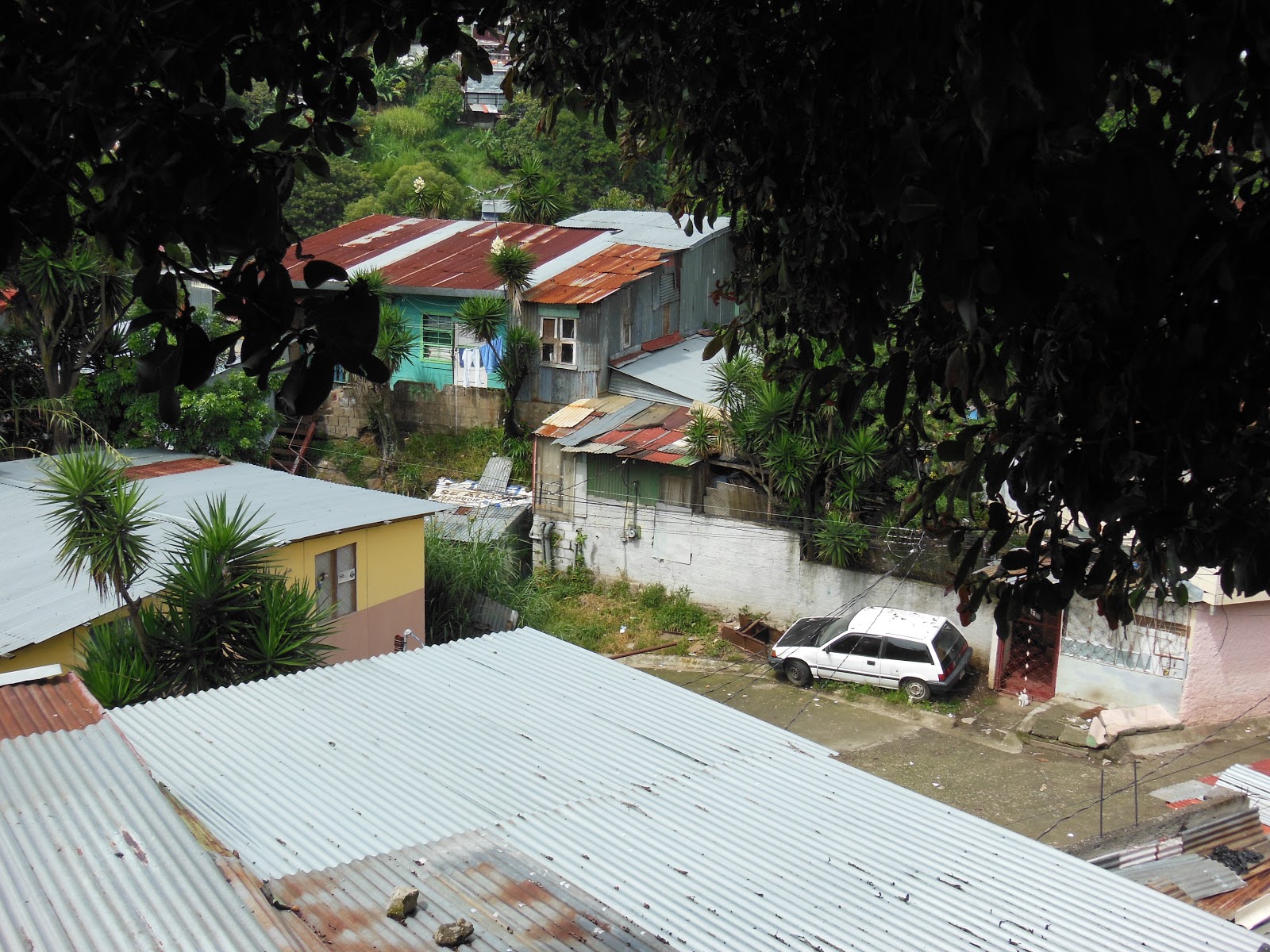 In fact, the biggest threat is the competitive and chaotic driving that the locals employ. Especially in the center of town, where a mix of overpopulated streets and imprudent pedestrians give way to the most unorganized and unkempt traffic I've witnessed.
I spent a restful night at Tomoko's house, a luxurious apartment complex. Not preposterous, yet definitely inconsistent with the squalid neighborhood not two hundred meters down the road, and the tin huts scattered across the mountains sighted from her eight floor balcony.
In the morning, aided by the amenable directions of the building's security guard, I explored my way to two different buses, one to the center of town, and from there to the airport. While waiting for Julia, I observed the mechanics of the lyrical battle between official airport taxi drivers and the competition; freelance bargainers always ready to offer you "ten dollars less sir!"
 The past two days have left the awe of discovery imprinted in our expression as we visited San José in our comings and goings while getting acquainted with the local culture and putting the finishing touches to our backpacks, or as Julia call hers, "my room." However, the most impactful experience was the hour long conversation with a curious and inspiring personality,
Gail, or Giselle, as the locals call her, unable to pronounce her name, has invited us to participate in a project that we couldn't be more excited about. We do not know yet the full extent of our involvement on the project, but she made it clear to us that we are to play a decisive role in the lives of the Cabécar indigenous community. Isolated from advancements in medicine, technology and dispersed in their own land, they have been in close contact with the Costa Rican Humanitarian Foundation for the past 15 years. The foundation has carried out a harmonious and fruitful effort to provide the community with education, adequate housing and modern communication tools; while managing to cultivate their desire to move forward but maintaining them as the conductors of progress. Despite the collaboration with the foundation, the Cabécares still lack many of the privileges that most of us would consider essential, even rudimentary.
 Starting tomorrow, we will live among them, hoping to teach as much as we will undoubtedly learn from them. For at least a month, we will be ever so fortunate to cohabitate with these shy and enigmatic people, assessing their situation and reporting back to Gail.
I dare not say more about this for fear of communicating false concepts, I'd rather be able to write on a blank page, than to have to write over the stains of an eraser.
Moments ago, we finished a most gratifying dinner with Tomoko, as we shared recipes from around the world. We provided Spanish Tortilla, while she served a savory home made plate of Japanese fried chicken, crowned with a palatable sauce and an assortment of vegetables. I'm typing this as Julia learns origami from Tomoko, and, counterintuitively, teaches her a folding trick of her own!
Tomorrow we leave San José at 6:30 in the morning and we don't know for sure when we will be in touch again.
We are forever grateful to Tomoko, Gail and the fate that brought us to them, for having placed this road before our feet.

Subscribe to:
Posts (Atom)