After six months of unanswered emails, worrying lack of news and uncertainty, we had admittedly began losing hope regarding any positive results from our work in Palmera, our first project of this trip. We had sent countless emails to the Costa Rican Humanitarian Foundation asking for news from the Cabecar Indigenous Reserve, and for the report we had written for them, so we could perhaps attract investment, tourism and volunteers to continue the process that the Foundation had started and we had enhanced during our nearly two months living with a local family. We had found a magnificent community, rich in resources and culture, but lacking in infrastructure. A very promising land where a terribly apathetic mindset obscured the vision of the future for the youth, despite their eagerness and commitment to education.
It was exactly with education, the bridge between preserving their ancestral history and bringing positive development to the community, where the key to the gate of the future lay for Palmera and the majority of its inhabitants. Although we focused our activities on strengthening the link between these two factors and improving local understanding of their importance, we hit a massive road block very early in the form of corruption.
The newly appointed principal of the high school had taken advantage of the seeds planted by his predecessor, now working a few hundred meters away as principal of the elementary school, and didn't take long to harvest the rewards. There was factual evidence that he was repeatedly using school funds for personal use, buying personal hygiene products, food and alcohol, as well as rather heavy accusations of drug use on school grounds and in the presence of students. In addition, the president of the board of education, otherwise known as the town drunk, had taken a liking to the methods of the new principal and soon became involved in these insidious activities. The most worrying result of these acts was the constant cancellation of classes, three or four times a week for lack of food in the school cafeteria, and the inability of the faculty to buy teaching materials. Teachers had to use their own money for such purchases.
The students displayed a flagrant mistrust in the educational system as was demonstrated by the lacklustre attendance, which was well under fifty percent. Many of the young boys would rather work with their fathers in the nearby plantations. The girls, many of whom were already mothers, could not afford to waste their precious time at a school that didn't provide a meal nor an education, and preferred to tend their domestic duties, as Cabecar tradition dictates.
Infuriated upon realizing this, and urged on by members of the community, teachers and students, we wrote a letter to the regional authorities and the local board of education, asking for an internal investigation, a new directive and a series of conditions in order to achieve transparency and a more efficient administration in the years to come.
The effects of the letter were immediate, although not as impactful as we had hoped. As news of a board meeting to assess the situation spread through the town, fierce tension invaded the faculty, the student body and the general population, as everyone began dividing between those who supported the principal and those who quietly disapproved. Fortunately, there was a third group: those who had taken a stand against the principal and the president of the board. Unfortunately, the group only consisted of our host family, the school cook, as the teachers who had initially inspired and incited us to take action, ultimately denied everything in fear of losing their jobs. The board meeting, which was dramatically similar to a court trial was hindered by the principal, who made sure it was scheduled during school hours so that the few students who were willing to take a stand against him would not attend. Much to our dismay, Leo, the father of our family forbid us from attending, fearing an angry reaction from the two characters involved, who had proven to be rather unpredictable.
As we had expected, without lack of support for our cause, the principal asserted his position at the board meeting, gaining support from the board members, whom he and the president had appointed. The appointees were illiterate, an unlawful situation, as we came to find out.
Our projects at the school became severely hampered on account of our actions, as we were no longer welcomed at the school. Some of the teachers were certainly reluctant to be seen speaking to us, so we spent most of our time with our family.
What had begun as an emotive and devoted campaign, ended quietly as we left Palmera without any visible results to our actions. Eventually, once we had the time and resources, we extended our letter to the Ministry of Education, but only received an acknowledgement of receipt from them. The past few months we had often wondered, albeit hopelessly, what had been of the situation in Palmera, and whether Leo, his family or anyone in town had fed the fire that we had ignited.
Surprisingly, yesterday we received a great piece of news from the Costa Rican Humanitarian Foundation.
The principal of the school has been sanctioned, and is being very carefully watched by the Ministry of Education. They are assessing the situation and may fire him in the coming weeks. From now on, the principal is not allowed to cancel classes, nor does he have access to funds, as it goes directly from the Ministry to the suppliers. The members of the board of education are now named democratically by the people and the student government has been given additional support and power. The people of Palmera are satisfied with these changes, which they directly attribute to the document we drafted in early November.
We left Palmera more than half a year ago, with an amazing experience to remember for the rest of our lives, but disappointed at being unable to make a lasting impact. Over the past few months, a mountain of disappointment had began to build on the foundations created during our time in Palmera as we poured our hearts and souls into several projects along the way but failed to see the end results. Thus, as you can imagine, it is extraordinarily rewarding and fulfilling to receive these news.
We can now see more clearly the importance of embroidering experiences, even the most marvelous ones, with actions which will last beyond memory.
"They are small things. They don't bring an end to poverty or lift us out of underdevelopment, they don't enforce social responsibility in means of production and exchange, and they don't expropriate Ali Baba's caves. But perhaps they set in motion the joy of doing, and translate it into specific acts. And, when all is said and done, acting on reality and changing it, although just a little bit, is the only way to prove that reality is transformable." - Eduardo Galeano (Uruguayan journalist and writer)
You can find the report we wrote to the Costa Rican Humanitarian Foundation and the letter to the Ministry of Education in our new 'Documents' section.
Showing posts with label environmental education. Show all posts
Showing posts with label environmental education. Show all posts
Tuesday, June 11, 2013

Saturday, March 9, 2013
San Isidro del General
There's a current stereotype circulating through the Central American isthmus which declares de Ticos to be arrogant, condescending and materialistic. In our three months in Costa Rica we met a wide variety of people of all ethnicities, professions and economic classes. Granted, we didn't visit the entire country, nor did we meet the entire population, but the people we did have the fortune of meeting proved otherwise.
 The fact is that, like most stereotypes, it is the stigma -and often the people whom adhere to it - that results as superficial and condescending. It seems ridiculous to expect a specific behavior from the grand
majority of a population as soon as you cross the threshold of a
country.
The fact is that, like most stereotypes, it is the stigma -and often the people whom adhere to it - that results as superficial and condescending. It seems ridiculous to expect a specific behavior from the grand
majority of a population as soon as you cross the threshold of a
country.
It would be interesting to investigate how such general judgments of character come to be, for, through traveling - or meeting travelers - one discovers that every person is unique, and that there are personality types of all sizes and colors in every country, region, city or neighborhood.
Of course, there are distinctive features in different cultures which set us apart from one another, which are often confused and called stereotypes. These are not stereotypes, they are traditions.
\
 We learned this the easy way, by tuning our daily routines in accordance to local conventions, in one of Costa Rica's most traditional towns. The most important city in the south Pacific region of the country, San Isidro dwells in the Valley of the General, cradled by the mountain ranges which forge the backbone of the country - a topographic spectacle. Comfortably sized and located, it offers an ideal alternative to the hectic, thick agglomeration of San Jose. On all sides, nature's elegant grandeur is expressed in variant forms.
The mountains host several types of ecosystems; lowland, cloud and highland forests, which alternate with each passing mile, as one circulates the torturous roads intersecting them.
 To the east, the beaches offer a convenient escape, only half an hour from the city. To the west, the highest peak in Costa Rica - Cerro Chirripo - oversees the development of the whole nation. At its feet, the steady traffic of the interamerican highway and the organic plantations; in the distance, volcanoes, jungles and the two oceans compete to attract international tourism.
During our stay in San Isidro del General we became acquainted with many people whom we will remember for a long, long time.
Everyone we crossed paths with during that month provided us with an opportunity to discover just how the stereotype strays far from the truth.
 The main contributors to making our sojourn such a special experience were Rafa, our coworker and flat-mate, who casually and gleefully shared his appartment and his humor with us; Beate and Federico, the founders and directors of Planet Conservation - the reason we were in San Isidro; and of course, our sweet and affectionate neighbor, Ester, who was accomodating beyond belief, and endued us with a sense of familiar belonging which is often longed when one is away from home during the holiday season.
At last but not least, are Diego and Karina, a young and spirited couple with a perennial duet of smiles and laughter. Not even Diego's blossoming music - an original fusion of the smooth warmth of bossa nova, the irreverent passion of a Latino and the soul filled energy of writing about one's own intimacies and skepticism - could surpass their immaculate attitude towards us.
Whether we were out having fun, working, or at home, all of these people and many others made sure that we had a home, friends and family.
 Despite working in an office - a rare setting for backpackers - we felt the mellowed detachment of a vacation much more than in Palmera. The main factor responsible for such an irreverent attitude towards standard office etiquette was the flexible ambiance of Planet Conservation. Federico and Beate have created a special atmosphere to work, perfectly adapted to the typical informality of the town. Music, jokes and laughter would blatantly eclipse the rustling sound of keyboards and printers. It was a rather enticing mood to work in, without being a time-consuming distraction. After all, at the end of the day, the work that needed to be done, was done.
Planet Conservation is a young organization specialized in serving as a link between tourists and students seeking to volunteer or intern at community based environmental and sustainable projects. In addition, they offer consulting to local businesses and hospitality establishments seeking to obtain green certification.
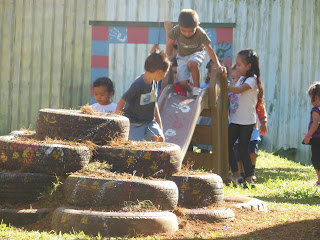 In celebration of their five year anniversary, they want to institute their own programs in order to directly participate in the preservation of the planet. Aside from routine office work such as translations or accounting, our main collaboration was in that department. We researched, drafted project proposals and searched for funding opportunities for two programs: turtle conservation and environmental education for children. In addition, we built a playground made of recycled materials in a kindergarten for children from low-income families; for which we gathered donations throughout the town.
Overall, our time in San Isidro was educational, interactive and inspirational. We were able to visit the mountains and the beach, made lifetime friendships, and met people of all characters and backgrounds, all willing to share their lives and homes with us.

 The fact is that, like most stereotypes, it is the stigma -and often the people whom adhere to it - that results as superficial and condescending. It seems ridiculous to expect a specific behavior from the grand
majority of a population as soon as you cross the threshold of a
country.
The fact is that, like most stereotypes, it is the stigma -and often the people whom adhere to it - that results as superficial and condescending. It seems ridiculous to expect a specific behavior from the grand
majority of a population as soon as you cross the threshold of a
country.It would be interesting to investigate how such general judgments of character come to be, for, through traveling - or meeting travelers - one discovers that every person is unique, and that there are personality types of all sizes and colors in every country, region, city or neighborhood.
Of course, there are distinctive features in different cultures which set us apart from one another, which are often confused and called stereotypes. These are not stereotypes, they are traditions.
\
 We learned this the easy way, by tuning our daily routines in accordance to local conventions, in one of Costa Rica's most traditional towns. The most important city in the south Pacific region of the country, San Isidro dwells in the Valley of the General, cradled by the mountain ranges which forge the backbone of the country - a topographic spectacle. Comfortably sized and located, it offers an ideal alternative to the hectic, thick agglomeration of San Jose. On all sides, nature's elegant grandeur is expressed in variant forms.
The mountains host several types of ecosystems; lowland, cloud and highland forests, which alternate with each passing mile, as one circulates the torturous roads intersecting them.

During our stay in San Isidro del General we became acquainted with many people whom we will remember for a long, long time.
Everyone we crossed paths with during that month provided us with an opportunity to discover just how the stereotype strays far from the truth.
 The main contributors to making our sojourn such a special experience were Rafa, our coworker and flat-mate, who casually and gleefully shared his appartment and his humor with us; Beate and Federico, the founders and directors of Planet Conservation - the reason we were in San Isidro; and of course, our sweet and affectionate neighbor, Ester, who was accomodating beyond belief, and endued us with a sense of familiar belonging which is often longed when one is away from home during the holiday season.
At last but not least, are Diego and Karina, a young and spirited couple with a perennial duet of smiles and laughter. Not even Diego's blossoming music - an original fusion of the smooth warmth of bossa nova, the irreverent passion of a Latino and the soul filled energy of writing about one's own intimacies and skepticism - could surpass their immaculate attitude towards us.
Whether we were out having fun, working, or at home, all of these people and many others made sure that we had a home, friends and family.

Planet Conservation is a young organization specialized in serving as a link between tourists and students seeking to volunteer or intern at community based environmental and sustainable projects. In addition, they offer consulting to local businesses and hospitality establishments seeking to obtain green certification.
 In celebration of their five year anniversary, they want to institute their own programs in order to directly participate in the preservation of the planet. Aside from routine office work such as translations or accounting, our main collaboration was in that department. We researched, drafted project proposals and searched for funding opportunities for two programs: turtle conservation and environmental education for children. In addition, we built a playground made of recycled materials in a kindergarten for children from low-income families; for which we gathered donations throughout the town.
Overall, our time in San Isidro was educational, interactive and inspirational. We were able to visit the mountains and the beach, made lifetime friendships, and met people of all characters and backgrounds, all willing to share their lives and homes with us.

Subscribe to:
Posts (Atom)