Showing posts with label adventure travel. Show all posts

Saturday, April 20, 2013

San Isidro to David - A hitchhiking mission

On January 17th, the eve of our intended entrance into Panama - a country of transit, of separation and union, of thin contour but thick authority -  we decided to avoid the easy yet expensive and uncomfortable bus ride through the mountainous section of the serpentine Interamerican Highway and the congested southern border crossing of Paso Canoas. Instead, we dove into the murky, unpredictable waters of hitchhiking. We were fully aware of the usual dangers associated with this alternative way of traveling, and wary of the particular risk of our undertaking, for we inescapably had to exit Costa Rica by the 19th, or else we would be forced to pay absurdly hefty fines.
We began the day as early as possible, in the fashion of what we now have began calling 'travel day', and after sharing a heartfelt 'see-you-later' with Esther, our neighbor, we set out to conquer the road. We erroneously thought that the best place to hitchhike would be the Interamerican Highway, for traffic is fluid and constant as it intersects San Isidro. After one hour of bypassing cars and trucks, whose drivers regarded us with distrust, disbelief, or mockery, we began to consider changing our spot and our route. Toute de suite, as we picked our bags up and headed to the other side of the city, a folksy local stopped a few meters down the road and offered us a ride 20 km out of the city. After a few minutes, our impromptu driver received a call urging him to return to San Isidro.
Perhaps more than any other incident that day, this opportune phone call would decisively alter the course of our hitchhiking adventure. This was an opportunity to frequent the coastal road. Our newest friend dropped us of in the western side of the city, where the road towards Playa Dominical begins. We learned that this path is preferred by those who descend towards Panama or the Costa Rican duty free paradise town of Golfito, as it is faster, straighter and more pleasant. In retrospect, it proved to be a good decision. Within a quarter of an hour we were in the back of a jeep with a couple of Jehova's Witnesses.

Much like on a snowy peak, one's emotions while hitchhiking can abruptly change from a restful blanket of powder snow into a rummaging avalanche swiftly occupying every inch in its path. Every time a friendly face breaks our expectant and patient wait to bring us closer to our final destination, an exhilaration of intrigue, nervousness and relief rushes through us.
Elated, we collect our cluster of bags and dart towards the car, as if afraid that the driver will regret his decision and take off before we can reach it.
One must be careful though, for all the excitement can play tricks on anyone, even the most responsible travelers. When a car does stop before you, remember that you most probably wont coincide with that person again, so it is always a good idea to double check your belongings before stepping out. Common sense would dictate so. It is common knowledge that common sense is not that common, although perhaps neither is knowledge. In any case, 'common sense' is often forgotten in times of urgency. That is why we recommend to turn this practice into routine.
Needless to say, we acquired this piece of advice by learning from experience, after forgetting our cell phone in the back seat of the Witnesses' car. Thankfully, a nearby information center allowed us to call our phone,  which we had remembered to charge the previous night (also an useful practice before 'travel day') and after a few attempts, they answered.
Fortunately, they hadn't gotten very far and, although a bit reluctant - understandably so - they committed to bringing it back to us. Between one thing and another, we had lost an hour of valuable time and potential rides, but we had all of our belongings and were once again ready to hit the road.

Little by little we advanced along the coastal road, including a ride which caught us right in the midst of preparing a pitiful but delicious road-side picnic. We were in no position to refuse a ride, but our half-made tuna and tomato sandwiches were not negotiable. So, we jumped into the car with the tuna half spread and the tomato half cut; juggling to stop them from dripping all over the backseat and eager to devour them.

After four kind drivers and ten hours on the road - on wheels as well as on the road's shoulder with our thumbs up - we suddenly found ourselves shelter-less, minutes from dusk, in one of those crooked, lawless towns born out of a junction, where good never stops and bad always returns. As darkness neared, we began to fear that our romance with the risk and intrigue of hitchhiking would result in rose petals on the ground. However, a desperately polite plea hurled to the swift passing of a car - one of many petitions lost in the dust and odor of the asphalt - met obliging ears. Not without prior conjugal resolution, Marcia and Andres, a couple with a turbulent past but kind and charitable disposition, turned the car around and offered us a ride to the border; and to their home.

We spent the night comfortably on an inflatable mattress installed on the kitchen floor of their humble home, ten minutes from the border. Without asking for anything in exchange, they shared their food, time, faith and life stories with us.
Having spent the best part of their youth as victims of poverty, crime and pitiless romance, both had now found in religion and each other the strength and wisdom to overcome the cruel adversities of life; which in Marcia's case included several years in prison. Not for a second did we feel frightened or uncomfortable after this revealing confession. In fact, we felt lady luck's smile shining above us once again after having found a couple so inclined to help us in such a precarious circumstance. The following morning, they prepared our last Tico breakfast (which consists of re-cooked rice and beans) and accompanied us to the frontier, where we complied with the necessary paperwork, and within an hour had entered into our second country: Panama!
This time, we only had to wait fifteen minutes for Edgar, a young Panamanian who also resorted to hitchhiking in his travels, and thus, did not hesitate to pick us up. As if it were customary when picking up hitchhikers, Edgar also treated us to a meal. Nonetheless, a meal and a ride wasn't enough for Edgar. He also took us to buy a Sim card for our phone and dropped us off at the doorstep of our hostel! Lastly, before we parted ways thinking we would never see this kind-hearted man again, he offered to take us to visit the mountains and beaches surrounding David, where one can find the touristic attractions of western Panama, aside from the over exploited archipelago of Bocas del Toro.

Incapable of wasting a chance to discover new places, just a few hours passed before we were in Edgar's car once again, heading to the famous mountain town of Boquete, a tourist favorite where an international coffee and flower festival was taking place. We spent a wonderful day in the mountains, but bypassed the festival, for it was an over hyped and overpriced magnet for easily impressed tourists and a reason for impoverished locals to spend their measly savings on alcohol. The mountains proved to be much more enticing, as we drove and walked through stunning cliffs, waterfalls and rivers. As we marveled at such a scenic contrast to the flat, dry, asphyxiating heat of David (just 40 minutes away) we discussed Panamanian politics and the ongoing power struggles between the implacable indigenous communities that reside in the mountains and the national government. The current government of Ricardo Martinelli has completely disregarded the autonomy of the Indigenous Comarcas (an Indian Reservation with the characteristic of a quasi-autonomous province) and unrelentingly sought to cash in on their untapped resources by granting construction permits to multinationals so they can build hydroelectric plants, mines and power lines to feed the increasing demand for resources and electricity in Panama City and Costa Rica.

Ironically, despite Edgar's antindustrialist comments and his advocation for traditional agriculture, sustainable development methods and the preservation of indigenous communities and the environment, he works at a hydroelectric plant; the main symbol of foreign industrial imposition, of economic disparity and rural underdevelopment in Panama. At first we were reluctant to hint at the hypocrisy of his words, but after a few more rendezvous we gained enough trust to engage in a conversation about the friction between ideals and reality, thought and action. He explained that in Panama the options for electromechanical engineers are few and limited, and that he had spent a great deal of time and money in university to end up working in low-income, low-satisfaction jobs. While we understood the desire to challenge himself and reach his full potential, we couldn't help but to think that the high pay was more motivation than the excitement of hydroelectricity or the lack of other options. Nonetheless, there is always another way.


It is precisely this type of conformism, exercised by those who know the repercussions of their actions, and who, above all, can chose other forms of employment, which contributes to the multiple obstacles in the path towards equality, justice, and sustainability. Just to clarify, we are not arguing in favor or against hydroelectric power, nor are we saying that Edgar is a bad guy - in fact he is generous, respectful and considerate far beyond the norm - but that is exactly what is frustrating, that even such an altruistic and knowledgeable person is not capable of sacrificing his standard of living or his career for the sake of his ideals or values. We believe that all of us are victims of comfort, and it is only when our own comfort is at risk, not when our beliefs are challenged, that we decide to act.

In David we stayed in a hostel called Purple House. As the name indicates, it is purple. The problem is that everything in the hostel is purple. The walls, chairs, plates, cups, blankets, furniture, decorations, doors, soap. Everything. Is. Purple. It's surprising that the owner - a serious, almost rude lady with a good heart and the need to please every client that steps in her hostel - isn't purple, or at least crazy. After a couple of days I began to feel a bit claustrophobic, or rather, porphyrophobic and was itching to move on to our next project and less monochromatic surroundings.
Thankfully, after three nights of interesting yet speculative conversations - a dogma of the backpacker - we finally managed to escape our halt and found our next destination: Soloy.
Although we didn't learn anything new about the secrets of human goodness and generosity, this experience allowed us to meet people of various backgrounds and unconditional generosity. In any case, we did ascertain that hitchhiking is not an outdated or extremely risky way to travel. Of course, this isn't true in every country, but if you employ routine caution, there is no reason to fear the worst and all the reasons to enjoy an alternative way to travel and meet people.

Saturday, March 9, 2013

San Isidro del General

There's a current stereotype circulating through the Central American isthmus which declares de Ticos to be arrogant, condescending and materialistic. In our three months in Costa Rica we met a wide variety of people of all ethnicities, professions and economic classes. Granted, we didn't visit the entire country, nor did we meet the entire population, but the people we did have the fortune of meeting proved otherwise.

The fact is that, like most stereotypes, it is the stigma -and often the people whom adhere to it - that results as superficial and condescending. It seems ridiculous to expect a specific behavior from the grand majority of a population as soon as you cross the threshold of a country.
It would be interesting to investigate how such general judgments of character come to be, for, through traveling - or meeting travelers - one discovers that every person is unique, and that there are personality types of all sizes and colors in every country, region, city or neighborhood.
Of course, there are distinctive features in different cultures which set us apart from one another, which are often confused and called stereotypes. These are not stereotypes, they are traditions.
\
We learned this the easy way, by tuning our daily routines in accordance to local conventions, in one of Costa Rica's most traditional towns. The most important city in the south Pacific region of the country, San Isidro dwells in the Valley of the General, cradled by the mountain ranges which forge the backbone of the country - a topographic spectacle. Comfortably sized and located, it offers an ideal alternative to the hectic, thick agglomeration of San Jose. On all sides, nature's elegant grandeur is expressed in variant forms.

The mountains host several types of ecosystems; lowland, cloud and highland forests, which alternate with each passing mile, as one circulates the torturous roads intersecting them.
To the east, the beaches offer a convenient escape, only half an hour from the city. To the west, the highest peak in Costa Rica - Cerro Chirripo - oversees the development of the whole nation. At its feet, the steady traffic of the interamerican highway and the organic plantations; in the distance, volcanoes, jungles and the two oceans compete to attract international tourism.
During our stay in San Isidro del General we became acquainted with many people whom we will remember for a long, long time.
 Everyone we crossed paths with during that month provided us with an opportunity to discover just how the stereotype strays far from the truth.

The main contributors to making our sojourn such a special experience were Rafa, our coworker and flat-mate, who casually and gleefully shared his appartment and his humor with us; Beate and Federico, the founders and directors of Planet Conservation - the reason we were in San Isidro; and of course, our sweet and affectionate neighbor, Ester, who was accomodating beyond belief, and endued us with a sense of familiar belonging which is often longed when one is away from home during the holiday season.


At last but not least, are Diego and Karina, a young and spirited couple with a perennial duet of smiles and laughter. Not even Diego's blossoming music - an original fusion of the smooth warmth of bossa nova, the irreverent passion of a Latino and the soul filled energy of writing about one's own intimacies and skepticism - could surpass their immaculate attitude towards us.
Whether we were out having fun, working, or at home, all of these people and many others made sure that we had a home, friends and family.

Despite working in an office - a rare setting for backpackers - we felt the mellowed detachment of a vacation much more than in Palmera. The main factor responsible for such an irreverent attitude towards standard office etiquette was the flexible ambiance of Planet Conservation. Federico and Beate have created a special atmosphere to work, perfectly adapted to the typical informality of the town. Music, jokes and laughter would blatantly eclipse the rustling sound of keyboards and printers. It was a rather enticing mood to work in, without being a time-consuming distraction. After all, at the end of the day, the work that needed to be done, was done.
Planet Conservation is a young organization specialized in serving as a link between tourists and students seeking to volunteer or intern at community based environmental and sustainable projects. In addition, they offer consulting to local businesses and hospitality establishments seeking to obtain green certification.

In celebration of their five year anniversary, they want to institute their own programs in order to directly participate in the preservation of the planet. Aside from routine office work such as translations or accounting, our main collaboration was in that department. We researched, drafted project proposals and searched for funding opportunities for two programs: turtle conservation and environmental education for children. In addition, we built a playground made of recycled materials in a kindergarten for children from low-income families; for which we gathered donations throughout the town.

Overall, our time in San Isidro was educational, interactive and inspirational. We were able to visit the mountains and the beach, made lifetime friendships, and met people of all characters and backgrounds, all willing to share their lives and homes with us.


Thursday, January 10, 2013

Boruca - New Year with the Devils


On the last day of 2012 we boarded yet another bus in our long list of ill-fitting buses and headed to Boruca, the main settlement within the Boruca Indigenous Reserve. Do not be mislead by the use of ill-fitting, for, despite their leisurely pace, the quality of the buses is more than sufficient. The problem at hand is that the seats are designed bearing in mind the average height of Costa Ricans, which, for men, is nearly 20 cm less than the stature of yours truly. As you can imagine, negotiating bumpy roads with barely a few inches of meager legroom and a vacuum behind your head which lets your neck wobble like a boxing ball is not a pleasant experience.

After a two hour journey during which we constantly had to ask our neighbors where we had to get off, the driver informed us that we had reached the entrance to Boruca. Unbeknownst to us, we were twelve kilometers of devastatingly steep, arid dirt away from the actual town.

In hindsight, we regarded the sheer path ahead of us and the gleaming noon sun with too much disdain. We nearly paid for our foolishness and disrespect when, after half an hour, unable to find a shade to rest, we began questioning if we had made the right decision. Luckily, a kind family coerced us into riding in the back of their pick-up truck and turned what would have been a painstaking five hour hike into a 30 minute rollercoaster ride through the jarring unpaved hills.

Once in the town, we installed our camping tent and proceeded to discover what the town had to offer, including a majestic waterfall and an ancient blend of dancing and bull-fighting.

Submerged in the Talamanca Mountains and encircled by the scenic valley of the Rio Grande de Terraba, this secluded site was once part of a vast territory. Before the arrival of the Spanish Empire in the 16th century, the Coto, Turruca, Borucac, Quepos and the Abubaes feuded over the region of the Pacific coast of Costa Rica, from present day Quepos to the frontier with Panama. Today, the Boruca are a composite group of nearly 2500 people, formed by the descendants of the dispersed tribes, who are said to have survived the invasion thanks to the aid of natural spirits.

Despite crowning a captivating mountain range and proudly boasting a phenomenally picturesque cultural tradition, Boruca is dreadfully indistinct from any ordinary Costa Rican town. Granted, this characteristic has positive and negative aspects.  

The first indigenous reserve to receive government aide, Boruca has been endowed with electricity, well equipped schools and a centralized structure for a quarter century. The view, otherwise rural and organic; adorned with banana-leaf-roofed ranchos, is abhorrently obstructed with cables, a massive cross, satellite dishes and a devastating amount of garbage.

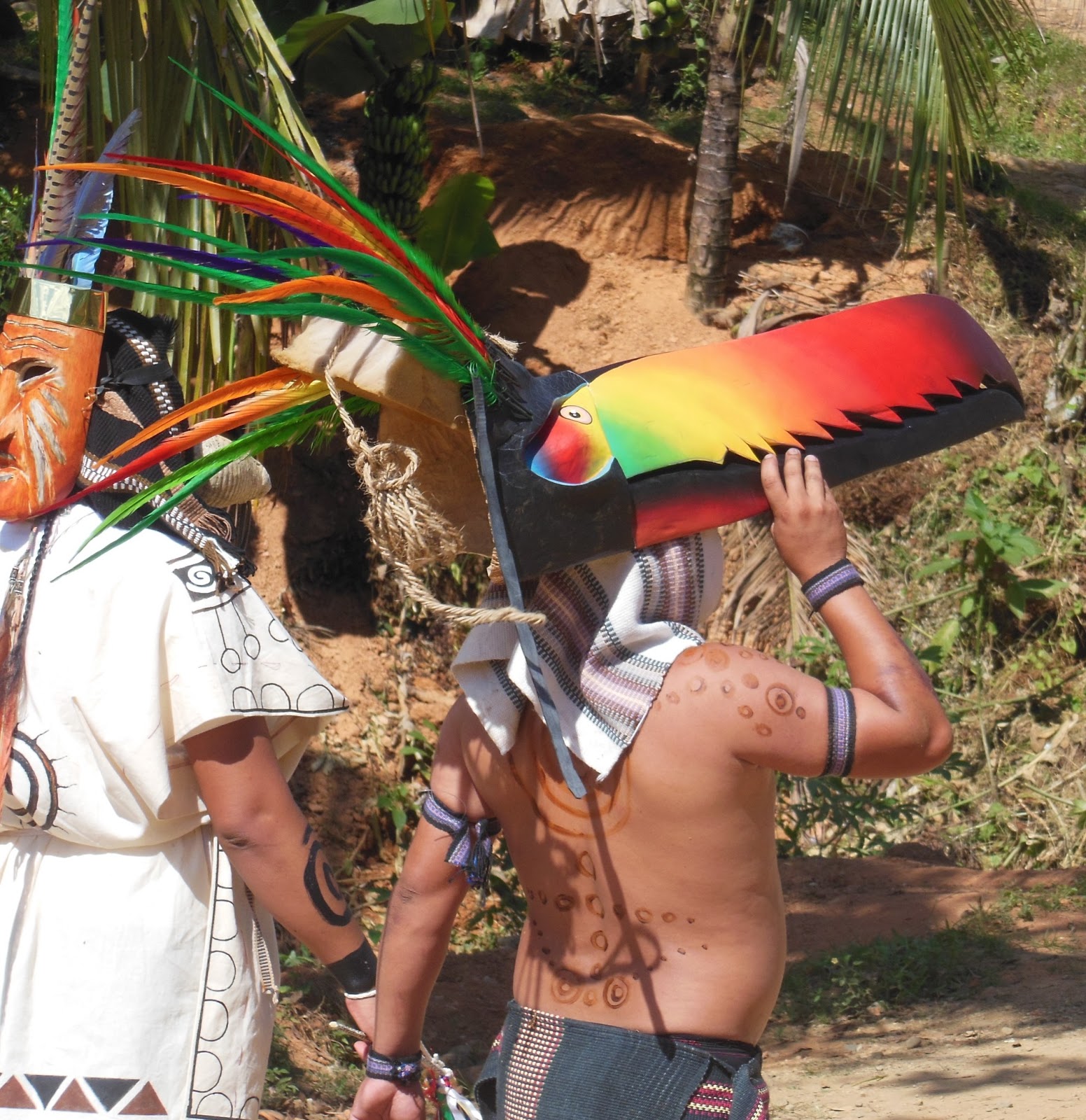
Tourists, often deceived into visiting insipid cultural sites, may consider the town fairly unexceptional if they visit during any other time of the year. But, peculiarly coinciding with the end of the Christian year, from the evening of December 30th until the twilight of January 2nd, the Borucas celebrate the Fiesta de los Diablitos (Festival of the Little Devils) in commemoration of their survival against the forces of Spanish conquistadors. This ritual with a side of party and a pinch of brawl is anything but dull. The festivity is a flaming showcase of their culture and spirit.

Minutes before midnight on December 30th, the town’s elder summons all the diablitos – basically any male over 15 years old – to his house. 

Once there, the diablitos commence parading the town stopping at every house to drink chicha (fermented corn liquor) and eat tamales. The diablitos wear intricate hand-carved and painted balsa wood masks and burlap sacks covered with jute and banana leaves. The procession is marked by the relentless collisions against a bull – a few of the men take turns carrying a heavy costume and bashing the diablitos– which represents the Spaniards.
The name ‘diablitos’, the horned masks, and the fighting symbolize the shrewdness, guile, courage and ardor that served them so well in resisting invading forces, while the sharing of drinks and food is indicative of their undeniable hospitality, not only among themselves, but with the few tourists who venture into the town to witness this astonishing display.

The masks are the main attraction and source of income throughout the year, when the diablitos drop their costumes and work in the fields, in San Jose or manufacturing masks and totems. However, during the festivity, it’s the evolving interaction with the bull that draws the most attention, as the diablitos, increasingly inebriated and aggressive, rampantly quarrel with the 40kg structure of the bull.
Adding to the uniquely vibrant imagery of Boruca during these dates, each diablito proudly and carefully carves and paints his own mask with colorful feathers, dramatic images of trees, flowers, animals and of course, hostile, menacing horns. Each mask is exclusively ornate, especially during the pinnacle of the feast, on January 2nd, when approximately 100 locals dress up and taunt the bull until it eventually gains ground and takes down all the diablitos. 

Then, the bull runs away, but the diablitos, inspired by the animal spirits that aided them centuries ago, rise from the dead, hunt down the bull and toss it into a blistering fire as they soar around the flames celebrating the victory. The revelry that ensues is even more exhilarating than in the previous nights, as the citizens of Boruca put on their best outfits and party well into the night.

So far we’ve had the chance to meet members of three different indigenous groups, while visiting two reserves. Despite being branded with the name ‘indigenous’, each of these groups is very different from the others, not only regarding cultural characteristics such as language, art and organization of society, but also with respect to progress and development – where they find themselves at this moment in history. 

Their openness to the world outside their barriers, their knowledge of world events, acceptance of tourism and external influences, as well as other aspects beyond their endemic culture are shaping their societies in ways undeterminably good or bad. Time will be the judge.

These groups continue to be called indigenous but the meaning and usage of this word has loosely dissipated in modern times. The Merriam-Webster dictionary defines indigenous as “having originated in and being produced, growing, or living naturally in a particular region or environment”.  
As for ‘indigenous peoples’, there is no universally accepted definition, but according to Wikipedia, there are three elements used to describe the term: the voluntary perpetuation of cultural distinctiveness, an experience of subjugation, marginalization and dispossession, and self-identification. However, according to these two definitions, most of the world’s population is indigenous. Surely, there must be something more to the essence of the word.

Colloquially, ‘indigenous’ is used to describe a close relationship with nature, respect for all things living, separation from the modern urban society, and the upholding of ancient traditions as core community values. Through the experiences of the last few months we have come to the realization that perhaps ‘indigenous’ is no longer a term to define a place of origin, but rather a way of living, a philosophy and a sentiment.

The indigenous people of Boruca, as well as many others throughout the world are in danger of extinction. ‘Being indigenous’ is not passed on genetically. It requires education, reason, sacrifice and determination.

Thus, the inhabitants of Boruca will continue to be called indigenous because they live in the land that their ancestors fought and cared for, and have the physical traits of their parents; but must of them won’t be indigenous in regards to the colloquial understanding of the word – unless they consciously choose so.

‘Being indigenous’ is not about being different, about suffering from marginalization and racism, but about preserving the unique and valuable elements of their ancestry. We’ve met many ‘indigenous people’ who do not enjoy a traditional way of living, or who do not respect nature, just as there are many ‘non-indigenous people’ throughout the world who share the indigenous philosophy.

Progress will come not through imposing or opening the doors to the modern world, but by building a bridge through which education, information and respect can travel both ways.


Tuesday, December 18, 2012

Cahuita

Lulled by the sound of calypso and reggae drifting through the heat of eternal summer, Cahuita lies in tranquility between Limon, the most important port of the South Caribbean; and Puerto Viejo, a haven for nonconformist renegades, surfers, tourists and backpackers. It is is escorted by an uninhibited, paradisaical black sand beach to the northwest and the monumental jungle of the Cahuita National Park to the southeast. This minuscule town is, metaphorically and geographically, wedged between two worlds.

Originally, the animals that are currently found in the National Park roamed freely, exempt from hunters. Visitors are easily delighted by the sloths, caymans, monkeys, snakes and several species of colorful birds that approach the jungle path conquered by ants and mosquitoes.

However, the green and hawksbill turtles that once chose the secluded shore to lay their eggs have long been absent from this breathtaking ecosystem.
In the 1750s, when only the most fearsome pirates dared navigate through the sheltering reef outlining the coast, the Miskito Indians of Nicaragua traveled south following the migration patterns of sea turtles in search of food. By 1828 they had permanently settled in the prominent tip, naming it “kawe” “ta”, or “point where the Sangrillo trees grow.” The sangrillo trees were of special significance to the new dwellers, for they used the red sap emanating from the trunks to dye their fishing nets, thus avoiding the reflection of the sun on the nets through the pristine waters.

In the 19th century, the slave ships traveling near the coast often collided with the treacherous reef. The natives, attentive and considerate, rescued the auspicious survivors who had just evaded a life of forced labor in the cocoa plantations. This altruistic practice gave birth to the current community of Afro-Caribbeans that give Cahuita its soul and essence. Today, the exotic cuisine, the long dreaded surfers, and the centenary, colorful wooden houses built on pillars serve as reminders of the town’s heritage. 
However, the traditional carefree demeanor of the Afro-Caribbean population has transformed into a lazy and detached attitude which has paved the roads of the picturesque town for foreigners trying to escape from their stressed and burdened lives. 

Increasingly, local businesses and jobs are seized by Europeans and North Americans, who arrive with more capital and proficiency. While the locals complain about the lack of job opportunities, the new residents blame them for their lack of interest and organization.
Nonetheless, there is one local whose interest in the progress of the community is unquestionable and whose struggle and determination are exemplary despite his years. His name is Winston Brooks. In an ironic parallel to his restaurant, whose superb quality is not demonstrated by its usually void tables, Winston is a man who projects intelligence and vigor beyond his humble and rusty appearance. "A duck wishing to be a chicken," he prefers the life of a farmer despite his private education and versed dialect. Thus, he hermits away in his farm, choosing the other Cahuita. The one that smells of sugarcane, labor and tar.


Although there is much to reveal about Winston and Cahuita's internal issues, we must first explain how we arrived at his doorstep.

On the morning of November 29th, we found ourselves wistfully but eagerly descending the mountain in pursue of our next adventure; leaving behind not just a remarkable family, but friends that would live in our hearts forever. Before exiting the Indigenous Territory, we picked up Irene, the campestral and buoyant Spanish teacher at the local high school. We had helped Irene with personal and professional matters during our time there, and in return, she put us in contact with Winston, who gladly invited us to stay at his Posada. As the usual route was obstructed by the flooded river, we were 

forced to deviate and hike for three hours through an infamous location known for armed robberies which ended with a hanging bridge much more frightening than any delinquent.
For this reason, we accompanied Irene on the way out, as Leo guided us through the dodgy, yet scenic trail.

After a hasty goodbye with Irene, one of many in our incipient journey, we arrived safely in Limon, following a quiet bus ride with Leo, as the three of us certainly contemplated our imminent farewell. Although we had lunch with Leo in Limon, the lingering feeling of separation made the meal a delay of events rather than an enjoyable final feast. Happily, before we realized, we were stepping off a bus in an intriguing new destination with an incurable air of summer bliss; Cahuita.

In Cahuita, we were met by Sonia, a spiritual nomad with a distinct Spanish guise. As she would likely say, life had taken her there, where she lived in Winston’s ancestral home with her boyfriend and Winston’s ex-wife, Lucy.

The home, worthy of a museum, is a 150 year old wooden structure which appears to stand on wishful thinking and temperament, rather than firm foundations. Adjacent to it is the Posada; erected but unpainted, and the restaurant; full with potential rather than clients.
During our time there, we walked through the streets, spent hours in the idyllic white beach of the national park and befriended a few charming locals, who were pleased to converse with visitors concerned with local events. Apart from being devoured by mosquitoes and marveling at the devastating force of the laboring ants, we spotted a baby sloth, iguanas, a basilisk, troops of howler monkeys and white-faced capuchins, caymans and a friendly talking parrot.
Whenever Winston was able, we would sit down with him and enjoy a captivating conversation about local politics, imperialism, or any relevant topic about which he could offer an opinionated view. During the day, he would work in his organic plantation, where he took us once so we could learn about the difference between bananas and plantains and how to plant them.

Our experience in Cahuita was brief yet unforgettable. There, we met all kinds of interesting characters with incredible backgrounds and stories. Its rich diversity – despite its minute size – is both an obstacle towards communal understanding and progress and an attraction for tourists of any kind. Its cultural and natural wealth is an ocean of fascinating creatures and tales, where one can spend days upon days wading through stories and adventures before realizing that time has swiftly gone by.


Tuesday, December 4, 2012

Wektë bas ra: Projects and Daily Life in Palmera

We arrived in Palmera on October 21st with a plethora of objectives. Some were commissioned by the Humanitarian Foundation, whereas others were personal. Our primary instruction from them was to complete a report which would enhance their understanding of the community, their progress and their needs. 
To do so, we carried out two workshops at  the local high school. One was dedicated to their academic and professional futures, in hope of encouraging them to continue their education after graduation and fulfil their potential. The other consisted of a cultural exchange, hoping to emphasize the importance of their identity; helping them comprehend the significance of retaining their native culture. For many of the students, it is a sacrifice to attend school everyday. Many of the females are mothers and housewives, while the young men could be earning a living for their families at the plantations. Furthermore, the average student walks for an hour to get to school, and some have to walk for up to three hours, as they live in houses wildly scattered across the mountain. Thus, we were incensed when we discovered a grave and pertinent problem affecting the educational institutions. Casually conversing with teachers, locals and in our visits to the school, we found out that a couple of key functionaries of the educational institutions were malignantly involved in negligence and embezzlement, leaving the students without lunch on a daily basis and the teachers without equipment. Having ignited our fire within, we urged them to take action. On behalf of the community, we helped them draft a letter to the regional authorities, asking for an internal investigation, a new directive and a series of requisites in order to achieve transparency and a more efficient administration in the years to come.

The foundation, who has been involved in numerous projects for the community, also collaborates closely with a group of artisan women. Envisioning increased visibility and documentation, we were asked to create a brief documentary on the intricate process of their craft; including pictures, videos and short biographies. However, we were disappointed by their lack of interest and cooperation when we summoned them to share their art. Sadly, the documentary will be undermined as a result. Similarly, the letter wasn´t signed by most of the people who initially endorsed it. What we initially thought to be fear of retribution may have turned out to be simply passivity or apathy. At the time of our departure, the powerful letter rested impotently in a dusty folder.

On a more positive note, we helped Leo, our host, write a proposal to build a lodge which will greatly improve the development and well being of the community. The Cabecar Cabin, as it will be named, will host tourists, students, researchers and will serve as a locale to impart technical courses. The foundation is now using this proposal to find the necessary funds to bring the project to life.

Needless to say, our time in Palmera was a rich and fruitful adventure, and the perfect beginning to our journey. Not a single day went by without a new experience or lesson.
For a month and a half, we were graciously hosted by a most exceptional indigenous family led by Genni and Leonel. Humbly but joyously, they live with Marilin (8), their cute and mischievous daughter, and their hardworking and curious son Junior (14), who loves Iron Maiden and playing the guitar. Their home is also graced by the presence of Genni´s lovely and bright stepsister Karen (10), who is a best friend and sister to Marilin; and Genni´s youngest brother Julio (16), who decided to leave the city of Limon and moved to Palmera this August, where he enjoys the peaceful and healthy life of the mountain and learns from Leo to become a working man.

In the mountain, away from electricity, the sun is the axis of time. There, daily life is ruled by the beaming star much more significantly than in the smog forests of concrete. Work, travel and any outdoor activity is determined by its light, and must first consult with its appearance. In a rare day at the reserve, we witnessed a momentous event in the advancement of the community. Curiously, it further increased their dependence on the sun. In the largest gathering we experienced, representatives of 35 households bought a small solar panel from a local development NGO. The panel gathers enough energy to power three light bulbs and charge a cellphone, but it is far from producing enough electricity to sustain all the needs of a modern home. Although lacking electricity has many repercussions, most of them are simple annoyances.
At dawn, the persistent rooster would succeed after three hours of irritating attempts of waking us from our   slumber. If rain was pouring, we stayed at home and wrote in our journals or drafted projects. We would read, relax in the hammock on the porch, play with the kids or philosophized as we contemplated the waterfalls cascading over the roof. Regularly, the rain would overflow the source of water used in the home - a small basin in the ravine a couple hundred meters into the forest. If so, we would accompany one of hosts, following the hose from the house through the scenic and wild creek.

When the weather permitted it, we would walk to the school or hike around the mountain, machete in hand. Also, we would help with domestic duties, such as cutting down trees, chopping them up for wood and carrying them back to the house; and collecting leaves and flowers to make paint, as well as picking oranges, lemons, cacao and other local fruits and vegetables. A week before the rain invaded us, we helped Leo dismantle the small warehouse adjoined to the house, and construct an additional room made of gorgeous red pilón (Hieronyma alchorneoides) taken from the "backyard".

Breakfast, lunch and diner consisted of rice, beans, and a boiled unripe banana. Often, they were accompanied by chicken, pork, or tuna, and never lacked a scrumptious glass of fresh juice. Vegetables would rarely be included in the meal. However, when they were, they had the flavour of fresh harvest that one can only savor in the mountain. Palmito (palm heart), shirabata (fern), malanga, yuca, carambola (starfruit) and sugar cane are some of the plants with which we delighted our palates. On occasion of our birthdays, we enjoyed a traditional feast, where we witnessed the slaughter of a 50 kg pig, which we marinated for a whole night and smoked it over a bonfire for a few hours. 

Before the rain dominated the local scenery, we would walk to the plaza at three in the afternoon, to participate barefoot in the mehenga - a pickup football game in a dirt field mined with cow excrement and sharp stones. Girls and boys of all ages above 15 played, showcasing their well trained abilities. Of course, they have a lot of practice, as football is the only sport leisure activity practiced by the community. Usually, we played until darkness would force us to return home covered in dirt, sweat and else. At the house, we would shower with the same water used for drinking and cooking, which is diverted to and from the "bath". Albeit cold, showering outdoors with buckets of water is revitalizing. In the late afternoon, as we waited for dinner, we would sing and play with the children or converse about culture and problems in the community or listen to stories. After dinner, we would retreat to our humble room by 7:30 pm, tired and fulfilled.