After six months of unanswered emails, worrying lack of news and uncertainty, we had admittedly began losing hope regarding any positive results from our work in Palmera, our first project of this trip. We had sent countless emails to the Costa Rican Humanitarian Foundation asking for news from the Cabecar Indigenous Reserve, and for the report we had written for them, so we could perhaps attract investment, tourism and volunteers to continue the process that the Foundation had started and we had enhanced during our nearly two months living with a local family. We had found a magnificent community, rich in resources and culture, but lacking in infrastructure. A very promising land where a terribly apathetic mindset obscured the vision of the future for the youth, despite their eagerness and commitment to education.
It was exactly with education, the bridge between preserving their ancestral history and bringing positive development to the community, where the key to the gate of the future lay for Palmera and the majority of its inhabitants. Although we focused our activities on strengthening the link between these two factors and improving local understanding of their importance, we hit a massive road block very early in the form of corruption.
The newly appointed principal of the high school had taken advantage of the seeds planted by his predecessor, now working a few hundred meters away as principal of the elementary school, and didn't take long to harvest the rewards. There was factual evidence that he was repeatedly using school funds for personal use, buying personal hygiene products, food and alcohol, as well as rather heavy accusations of drug use on school grounds and in the presence of students. In addition, the president of the board of education, otherwise known as the town drunk, had taken a liking to the methods of the new principal and soon became involved in these insidious activities. The most worrying result of these acts was the constant cancellation of classes, three or four times a week for lack of food in the school cafeteria, and the inability of the faculty to buy teaching materials. Teachers had to use their own money for such purchases.
The students displayed a flagrant mistrust in the educational system as was demonstrated by the lacklustre attendance, which was well under fifty percent. Many of the young boys would rather work with their fathers in the nearby plantations. The girls, many of whom were already mothers, could not afford to waste their precious time at a school that didn't provide a meal nor an education, and preferred to tend their domestic duties, as Cabecar tradition dictates.
Infuriated upon realizing this, and urged on by members of the community, teachers and students, we wrote a letter to the regional authorities and the local board of education, asking for an internal investigation, a new directive and a series of conditions in order to achieve transparency and a more efficient administration in the years to come.
The effects of the letter were immediate, although not as impactful as we had hoped. As news of a board meeting to assess the situation spread through the town, fierce tension invaded the faculty, the student body and the general population, as everyone began dividing between those who supported the principal and those who quietly disapproved. Fortunately, there was a third group: those who had taken a stand against the principal and the president of the board. Unfortunately, the group only consisted of our host family, the school cook, as the teachers who had initially inspired and incited us to take action, ultimately denied everything in fear of losing their jobs. The board meeting, which was dramatically similar to a court trial was hindered by the principal, who made sure it was scheduled during school hours so that the few students who were willing to take a stand against him would not attend. Much to our dismay, Leo, the father of our family forbid us from attending, fearing an angry reaction from the two characters involved, who had proven to be rather unpredictable.
As we had expected, without lack of support for our cause, the principal asserted his position at the board meeting, gaining support from the board members, whom he and the president had appointed. The appointees were illiterate, an unlawful situation, as we came to find out.
Our projects at the school became severely hampered on account of our actions, as we were no longer welcomed at the school. Some of the teachers were certainly reluctant to be seen speaking to us, so we spent most of our time with our family.
What had begun as an emotive and devoted campaign, ended quietly as we left Palmera without any visible results to our actions. Eventually, once we had the time and resources, we extended our letter to the Ministry of Education, but only received an acknowledgement of receipt from them. The past few months we had often wondered, albeit hopelessly, what had been of the situation in Palmera, and whether Leo, his family or anyone in town had fed the fire that we had ignited.
Surprisingly, yesterday we received a great piece of news from the Costa Rican Humanitarian Foundation.
The principal of the school has been sanctioned, and is being very carefully watched by the Ministry of Education. They are assessing the situation and may fire him in the coming weeks. From now on, the principal is not allowed to cancel classes, nor does he have access to funds, as it goes directly from the Ministry to the suppliers. The members of the board of education are now named democratically by the people and the student government has been given additional support and power. The people of Palmera are satisfied with these changes, which they directly attribute to the document we drafted in early November.
We left Palmera more than half a year ago, with an amazing experience to remember for the rest of our lives, but disappointed at being unable to make a lasting impact. Over the past few months, a mountain of disappointment had began to build on the foundations created during our time in Palmera as we poured our hearts and souls into several projects along the way but failed to see the end results. Thus, as you can imagine, it is extraordinarily rewarding and fulfilling to receive these news.
We can now see more clearly the importance of embroidering experiences, even the most marvelous ones, with actions which will last beyond memory.
"They are small things. They don't bring an end to poverty or lift us out of underdevelopment, they don't enforce social responsibility in means of production and exchange, and they don't expropriate Ali Baba's caves. But perhaps they set in motion the joy of doing, and translate it into specific acts. And, when all is said and done, acting on reality and changing it, although just a little bit, is the only way to prove that reality is transformable." - Eduardo Galeano (Uruguayan journalist and writer)
You can find the report we wrote to the Costa Rican Humanitarian Foundation and the letter to the Ministry of Education in our new 'Documents' section.
Showing posts with label discovery. Show all posts
Showing posts with label discovery. Show all posts
Tuesday, June 11, 2013

Saturday, March 9, 2013
San Isidro del General
There's a current stereotype circulating through the Central American isthmus which declares de Ticos to be arrogant, condescending and materialistic. In our three months in Costa Rica we met a wide variety of people of all ethnicities, professions and economic classes. Granted, we didn't visit the entire country, nor did we meet the entire population, but the people we did have the fortune of meeting proved otherwise.
 The fact is that, like most stereotypes, it is the stigma -and often the people whom adhere to it - that results as superficial and condescending. It seems ridiculous to expect a specific behavior from the grand
majority of a population as soon as you cross the threshold of a
country.
The fact is that, like most stereotypes, it is the stigma -and often the people whom adhere to it - that results as superficial and condescending. It seems ridiculous to expect a specific behavior from the grand
majority of a population as soon as you cross the threshold of a
country.
It would be interesting to investigate how such general judgments of character come to be, for, through traveling - or meeting travelers - one discovers that every person is unique, and that there are personality types of all sizes and colors in every country, region, city or neighborhood.
Of course, there are distinctive features in different cultures which set us apart from one another, which are often confused and called stereotypes. These are not stereotypes, they are traditions.
\
 We learned this the easy way, by tuning our daily routines in accordance to local conventions, in one of Costa Rica's most traditional towns. The most important city in the south Pacific region of the country, San Isidro dwells in the Valley of the General, cradled by the mountain ranges which forge the backbone of the country - a topographic spectacle. Comfortably sized and located, it offers an ideal alternative to the hectic, thick agglomeration of San Jose. On all sides, nature's elegant grandeur is expressed in variant forms.
The mountains host several types of ecosystems; lowland, cloud and highland forests, which alternate with each passing mile, as one circulates the torturous roads intersecting them.
 To the east, the beaches offer a convenient escape, only half an hour from the city. To the west, the highest peak in Costa Rica - Cerro Chirripo - oversees the development of the whole nation. At its feet, the steady traffic of the interamerican highway and the organic plantations; in the distance, volcanoes, jungles and the two oceans compete to attract international tourism.
During our stay in San Isidro del General we became acquainted with many people whom we will remember for a long, long time.
Everyone we crossed paths with during that month provided us with an opportunity to discover just how the stereotype strays far from the truth.
 The main contributors to making our sojourn such a special experience were Rafa, our coworker and flat-mate, who casually and gleefully shared his appartment and his humor with us; Beate and Federico, the founders and directors of Planet Conservation - the reason we were in San Isidro; and of course, our sweet and affectionate neighbor, Ester, who was accomodating beyond belief, and endued us with a sense of familiar belonging which is often longed when one is away from home during the holiday season.
At last but not least, are Diego and Karina, a young and spirited couple with a perennial duet of smiles and laughter. Not even Diego's blossoming music - an original fusion of the smooth warmth of bossa nova, the irreverent passion of a Latino and the soul filled energy of writing about one's own intimacies and skepticism - could surpass their immaculate attitude towards us.
Whether we were out having fun, working, or at home, all of these people and many others made sure that we had a home, friends and family.
 Despite working in an office - a rare setting for backpackers - we felt the mellowed detachment of a vacation much more than in Palmera. The main factor responsible for such an irreverent attitude towards standard office etiquette was the flexible ambiance of Planet Conservation. Federico and Beate have created a special atmosphere to work, perfectly adapted to the typical informality of the town. Music, jokes and laughter would blatantly eclipse the rustling sound of keyboards and printers. It was a rather enticing mood to work in, without being a time-consuming distraction. After all, at the end of the day, the work that needed to be done, was done.
Planet Conservation is a young organization specialized in serving as a link between tourists and students seeking to volunteer or intern at community based environmental and sustainable projects. In addition, they offer consulting to local businesses and hospitality establishments seeking to obtain green certification.
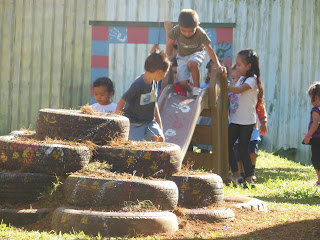 In celebration of their five year anniversary, they want to institute their own programs in order to directly participate in the preservation of the planet. Aside from routine office work such as translations or accounting, our main collaboration was in that department. We researched, drafted project proposals and searched for funding opportunities for two programs: turtle conservation and environmental education for children. In addition, we built a playground made of recycled materials in a kindergarten for children from low-income families; for which we gathered donations throughout the town.
Overall, our time in San Isidro was educational, interactive and inspirational. We were able to visit the mountains and the beach, made lifetime friendships, and met people of all characters and backgrounds, all willing to share their lives and homes with us.

 The fact is that, like most stereotypes, it is the stigma -and often the people whom adhere to it - that results as superficial and condescending. It seems ridiculous to expect a specific behavior from the grand
majority of a population as soon as you cross the threshold of a
country.
The fact is that, like most stereotypes, it is the stigma -and often the people whom adhere to it - that results as superficial and condescending. It seems ridiculous to expect a specific behavior from the grand
majority of a population as soon as you cross the threshold of a
country.It would be interesting to investigate how such general judgments of character come to be, for, through traveling - or meeting travelers - one discovers that every person is unique, and that there are personality types of all sizes and colors in every country, region, city or neighborhood.
Of course, there are distinctive features in different cultures which set us apart from one another, which are often confused and called stereotypes. These are not stereotypes, they are traditions.
\
 We learned this the easy way, by tuning our daily routines in accordance to local conventions, in one of Costa Rica's most traditional towns. The most important city in the south Pacific region of the country, San Isidro dwells in the Valley of the General, cradled by the mountain ranges which forge the backbone of the country - a topographic spectacle. Comfortably sized and located, it offers an ideal alternative to the hectic, thick agglomeration of San Jose. On all sides, nature's elegant grandeur is expressed in variant forms.
The mountains host several types of ecosystems; lowland, cloud and highland forests, which alternate with each passing mile, as one circulates the torturous roads intersecting them.

During our stay in San Isidro del General we became acquainted with many people whom we will remember for a long, long time.
Everyone we crossed paths with during that month provided us with an opportunity to discover just how the stereotype strays far from the truth.
 The main contributors to making our sojourn such a special experience were Rafa, our coworker and flat-mate, who casually and gleefully shared his appartment and his humor with us; Beate and Federico, the founders and directors of Planet Conservation - the reason we were in San Isidro; and of course, our sweet and affectionate neighbor, Ester, who was accomodating beyond belief, and endued us with a sense of familiar belonging which is often longed when one is away from home during the holiday season.
At last but not least, are Diego and Karina, a young and spirited couple with a perennial duet of smiles and laughter. Not even Diego's blossoming music - an original fusion of the smooth warmth of bossa nova, the irreverent passion of a Latino and the soul filled energy of writing about one's own intimacies and skepticism - could surpass their immaculate attitude towards us.
Whether we were out having fun, working, or at home, all of these people and many others made sure that we had a home, friends and family.

Planet Conservation is a young organization specialized in serving as a link between tourists and students seeking to volunteer or intern at community based environmental and sustainable projects. In addition, they offer consulting to local businesses and hospitality establishments seeking to obtain green certification.
 In celebration of their five year anniversary, they want to institute their own programs in order to directly participate in the preservation of the planet. Aside from routine office work such as translations or accounting, our main collaboration was in that department. We researched, drafted project proposals and searched for funding opportunities for two programs: turtle conservation and environmental education for children. In addition, we built a playground made of recycled materials in a kindergarten for children from low-income families; for which we gathered donations throughout the town.
Overall, our time in San Isidro was educational, interactive and inspirational. We were able to visit the mountains and the beach, made lifetime friendships, and met people of all characters and backgrounds, all willing to share their lives and homes with us.

Monday, December 31, 2012
Infiltrated volunteers: Matapalo
It’s remarkably inspiring to witness the
amount of people who gladly sacrifice their time, and often
money, to become part of a cause much larger than themselves. Since arriving in
San Isidro in early December, we have had the chance to meet and work with
several volunteers. Whether they are committing their efforts entirely selflessly
or as a way to expand their knowledge on a specific subject, the result is undeniably
constructive.
Volunteering is able to decrease the
disparities in society, such as poverty, segregation and exclusion. The pillars
of volunteerism; solidarity and commitment are comforting constants upon which
we can rely as the driving force for the crucial adjustments we must make to
our way of living; both as individuals and as a society. The principles of
volunteerism are remarkably pertinent in increasing the competence of those
exposed, vulnerable and weak so they can attain a safe and sustainable living
situation as well as to improve their physical, financial, spiritual and social
well-being.
 Although by many standards we are
considered volunteers, we have decided to create a different term for our
specific situation to be able to differentiate ourselves from the many charitable
people we have crossed during our work at Planet Conservation. We have recently
begun calling ourselves “freelance volunteers”. By no means do we intend to emphasize
our work with this differentiation. In fact, our work lacks any real, or
quantitative, value until we finish the journey and are able to produce substantial
and defined conclusions, while ‘regular’ volunteering yields direct results.
Although by many standards we are
considered volunteers, we have decided to create a different term for our
specific situation to be able to differentiate ourselves from the many charitable
people we have crossed during our work at Planet Conservation. We have recently
begun calling ourselves “freelance volunteers”. By no means do we intend to emphasize
our work with this differentiation. In fact, our work lacks any real, or
quantitative, value until we finish the journey and are able to produce substantial
and defined conclusions, while ‘regular’ volunteering yields direct results.
 Although by many standards we are
considered volunteers, we have decided to create a different term for our
specific situation to be able to differentiate ourselves from the many charitable
people we have crossed during our work at Planet Conservation. We have recently
begun calling ourselves “freelance volunteers”. By no means do we intend to emphasize
our work with this differentiation. In fact, our work lacks any real, or
quantitative, value until we finish the journey and are able to produce substantial
and defined conclusions, while ‘regular’ volunteering yields direct results.
Although by many standards we are
considered volunteers, we have decided to create a different term for our
specific situation to be able to differentiate ourselves from the many charitable
people we have crossed during our work at Planet Conservation. We have recently
begun calling ourselves “freelance volunteers”. By no means do we intend to emphasize
our work with this differentiation. In fact, our work lacks any real, or
quantitative, value until we finish the journey and are able to produce substantial
and defined conclusions, while ‘regular’ volunteering yields direct results.
In fact, we began calling ourselves this
rather pompous name when we attempted to explain the type of work we have been
doing and not many people seemed to understand that we have traveled here on
our own account. While we have the most sincere respect for genuine eco-volunteering
and ‘voluntourism’, we are not in the business of paying to do work. Our trip
has different goals.

We do not intend to limit our work to
foundations, NGOs, or government projects. It has been repeatedly but
appropriately recognized that small acts can have a huge impact. Groups of
organized neighbors, families and even individuals can immensely influence
other people’s lives, communities and the habitat that surrounds them. These
actions, born out of altruism are perhaps more effective than those of massive, institutionalized, bureaucratic organizations.
After only one week of living in San
Isidro we got to discover just how powerful a relatively small act can become.
Not only in the purpose of the act itself, but in the economic and moral
improvement of a whole community.

Moved by what she considered a problem of
utmost significance, she convinced her family to build a makeshift hatchery in
their backyard. Judiciously, they would patrol the beach at night in search of nesting
mothers. As the turtles placidly descended towards the ocean after finishing
the phenomenal, yet arduous task of laying eggs, they would run in and
carefully excavate the camouflaged pits and take the eggs to the hatchery,
where they could shelter the hundreds of unborn hatchlings from menacing predators.

Our placement at Planet Conservation was
opportune enough that we were able to spend a weekend visiting the project
before turtle season ended. The motive for deploying us at the Matapalo Project
was to examine and analyze how a turtle conservation program operates. For
three days, we lived and worked as regular volunteers in the ASVO house. We
were ecstatic about the prospect of witnessing a turtle (although not an arribada, a communal arrival of hundreds
of turtles for a few nights) or perhaps the birth of a nest; but our chances
were faint, given that the season was practically over. Our main hope resided
on the mere eight nests that remained in the hatchery.

It was too much to ask to see a turtle, but we did enjoy the serenity of
walking through a misty beach depending only on the stars and a couple of
fishing boats for illumination. Patrolling is only one of the many duties of
the volunteers and staff. Depending on the month, various teams ranging from
one to three people keep their eyes peeled as they march through the sand
retrieving nests.

On Saturday, our second day at the
project, we participated in cleaning duties, played a rough football match on the beach and celebrated an early Christmas with the staff and volunteers, who joined hands to cook a lavish feast of local dishes. In the afternoon, we visited the edge of a natural park; where a river, a beach and a forest have created a peaceful sanctuary.
On our second and final night we were
appointed to guard the hatchery from midnight until four in the morning. Since
we didn’t want to miss the possible, but improbable birth of baby turtles, we
asked the volunteers taking the first shift to warn us in case of any hatchings.
To their surprise, they encountered a nest full of nervous hatchlings, zealously
waiting to flee for the open ocean.
 With
the fresh, luscious taste of passion fruit mousse lingering in our palates, we
eagerly bequeathed our unfinished plates and sprinted towards the hatchery.
With
the fresh, luscious taste of passion fruit mousse lingering in our palates, we
eagerly bequeathed our unfinished plates and sprinted towards the hatchery.
Methodically, but unable to conceal our
enthusiasm, we counted the 85 newborns and moved them to the beach in a large container.
Our hands were tremulous with excitement, as we set the bucket down six meters
from the water and carefully placed every single courageous little creature on
the sand. Once the last of the instinctive wanderlusters had departed, the
nervous giggle we had uttered throughout the process was suddenly amplified
into a triumphant, exuberant laughter to escort the turtles past the
breaking waves as it echoed in the dark.
We couldn’t help but compare our lives to
those of the valiant young turtles. The adorable, even jocular display is a
rather didactic event for us. Yet to taste the sweet tenderness of a mother’s
care, they must confront many of nature’s most bitter lessons. The friable pack
embarks without any deliberation on a quest towards a most unsure and ambiguous
objective; life. Granted, instinct, not reason, is the driving force of their
actions. But wouldn’t our lives be more valuable, and worth living if we devoted
them to do what we know to be right without fear of the obstacles that may stand in our
path?

Tuesday, December 4, 2012
Wektë bas ra: Projects and Daily Life in Palmera
We arrived in Palmera on October 21st with a plethora of objectives. Some were commissioned by the Humanitarian Foundation, whereas others were personal. Our primary instruction from them was to complete a report which would enhance their understanding of the community, their progress and their needs.

To do so, we carried out two workshops at the local high school. One was dedicated to their academic and professional futures, in hope of encouraging them to continue their education after graduation and fulfil their potential. The other consisted of a cultural exchange, hoping to emphasize the importance of their identity; helping them comprehend the significance of retaining their native culture. For many of the students, it is a sacrifice to attend school everyday. Many of the females are mothers and housewives, while the young men could be earning a living for their families at the plantations. Furthermore, the average student walks for an hour to get to school, and some have to walk for up to three hours, as they live in houses wildly scattered across the mountain. Thus, we were incensed when we discovered a grave and pertinent problem affecting the educational institutions. Casually conversing with teachers, locals and in our visits to the school, we found out that a couple of key functionaries of the educational institutions were malignantly involved in negligence and embezzlement, leaving the students without lunch on a daily basis and the teachers without equipment. Having ignited our fire within, we urged them to take action. On behalf of the community, we helped them draft a letter to the regional authorities, asking for an internal investigation, a new directive and a series of requisites in order to achieve transparency and a more efficient administration in the years to come.
 The foundation, who has been involved in numerous projects for the community, also collaborates closely with a group of artisan women. Envisioning increased visibility and documentation, we were asked to create a brief documentary on the intricate process of their craft; including pictures, videos and short biographies. However, we were disappointed by their lack of interest and cooperation when we summoned them to share their art. Sadly, the documentary will be undermined as a result. Similarly, the letter wasn´t signed by most of the people who initially endorsed it. What we initially thought to be fear of retribution may have turned out to be simply passivity or apathy. At the time of our departure, the powerful letter rested impotently in a dusty folder.
On a more positive note, we helped Leo, our host, write a proposal to build a lodge which will greatly improve the development and well being of the community. The Cabecar Cabin, as it will be named, will host tourists, students, researchers and will serve as a locale to impart technical courses. The foundation is now using this proposal to find the necessary funds to bring the project to life.
 Needless to say, our time in Palmera was a rich and fruitful adventure, and the perfect beginning to our journey. Not a single day went by without a new experience or lesson.
For a month and a half, we were graciously hosted by a most exceptional indigenous family led by Genni and Leonel. Humbly but joyously, they live with Marilin (8), their cute and mischievous daughter, and their hardworking and curious son Junior (14), who loves Iron Maiden and playing the guitar. Their home is also graced by the presence of Genni´s lovely and bright stepsister Karen (10), who is a best friend and sister to Marilin; and Genni´s youngest brother Julio (16), who decided to leave the city of Limon and moved to Palmera this August, where he enjoys the peaceful and healthy life of the mountain and learns from Leo to become a working man.
 In the mountain, away from electricity, the sun is the axis of time. There, daily life is ruled by the beaming star much more significantly than in the smog forests of concrete. Work, travel and any outdoor activity is determined by its light, and must first consult with its appearance. In a rare day at the reserve, we witnessed a momentous event in the advancement of the community. Curiously, it further increased their dependence on the sun. In the largest gathering we experienced, representatives of 35 households bought a small solar panel from a local development NGO. The panel gathers enough energy to power three light bulbs and charge a cellphone, but it is far from producing enough electricity to sustain all the needs of a modern home. Although lacking electricity has many repercussions, most of them are simple annoyances.
At dawn, the persistent rooster would succeed after three hours of irritating attempts of waking us from our slumber. If rain was pouring, we stayed at home and wrote in our journals or drafted projects. We would read, relax in the hammock on the porch, play with the kids or philosophized as we contemplated the waterfalls cascading over the roof. Regularly, the rain would overflow the source of water used in the home - a small basin in the ravine a couple hundred meters into the forest. If so, we would accompany one of hosts, following the hose from the house through the scenic and wild creek.
 When the weather permitted it, we would walk to the school or hike around the mountain, machete in hand. Also, we would help with domestic duties, such as cutting down trees, chopping them up for wood and carrying them back to the house; and collecting leaves and flowers to make paint, as well as picking oranges, lemons, cacao and other local fruits and vegetables. A week before the rain invaded us, we helped Leo dismantle the small warehouse adjoined to the house, and construct an additional room made of gorgeous red pilón (Hieronyma alchorneoides) taken from the "backyard".
 Breakfast, lunch and diner consisted of rice, beans, and a boiled unripe banana. Often, they were accompanied by chicken, pork, or tuna, and never lacked a scrumptious glass of fresh juice. Vegetables would rarely be included in the meal. However, when they were, they had the flavour of fresh harvest that one can only savor in the mountain. Palmito (palm heart), shirabata (fern), malanga, yuca, carambola (starfruit) and sugar cane are some of the plants with which we delighted our palates. On occasion of our birthdays, we enjoyed a traditional feast, where we witnessed the slaughter of a 50 kg pig, which we marinated for a whole night and smoked it over a bonfire for a few hours.
Before the rain dominated the local scenery, we would walk to the plaza at three in the afternoon, to participate barefoot in the mehenga - a pickup football game in a dirt field mined with cow excrement and sharp stones. Girls and boys of all ages above 15 played, showcasing their well trained abilities. Of course, they have a lot of practice, as football is the only sport leisure activity practiced by the community. Usually, we played until darkness would force us to return home covered in dirt, sweat and else. At the house, we would shower with the same water used for drinking and cooking, which is diverted to and from the "bath". Albeit cold, showering outdoors with buckets of water is revitalizing. In the late afternoon, as we waited for dinner, we would sing and play with the children or converse about culture and problems in the community or listen to stories. After dinner, we would retreat to our humble room by 7:30 pm, tired and fulfilled.

Saturday, December 1, 2012
Jishtiä ba shkina: Cabecar Culture and Landscape

Deep in the jungle, where the imposing Cordillera Central begins its
steep bow to the flatlands, the Cabecar community of Palmera live
sheltered by the effervescent Zent river. From there, a sea of
plantations distance the indians from the susceptible waters of the
Caribbean, painting a never ending horizon melted between the clouds and
the murky tree tops.
Two hours uphill from the river ‒ a bastion
between two cultures struggling to coexist ‒ an exceptional family
shared their home, lifestyle and affection with us for a month and a
half. Their insatiable curiosity, motivation and courage made our
stay a blissful and uniquely memorable experience.
There, only the
patios are cleared for the commodity of the inhabitants. Every other
inch of land is cloaked with an uncontrollable curtain of green, which
impetuously overflows into the prints of humankind. The diverse and
lively rain forest is appalling; palm trees of every kind, centenary
giants, covered with vines which sprout from everywhere and climb the
massive columns of red, white and green bark. Also, fleeting specs of
colorful birds, frogs and flowery ornaments adorn the evergreen sight.
Fortuitously, toucans, parrots, lovebirds and smaller melodies in motion would visit the line of trees around the house, thus announcing a halt to the incessant rain.
 For
the first three weeks, the sun burned our skin, sharply, as if through a
magnifying glass. The rain, backstage, awaited its opportunity to shine
- or rather, dim - briefly appearing to freshen the air and feed the
soil. At night, the moon was a mirror image of the sun, projecting all
of its might. It shone so bright that shadows grew from our feet as we
marvelled at the infinite spectacle of the milky way.
For
the first three weeks, the sun burned our skin, sharply, as if through a
magnifying glass. The rain, backstage, awaited its opportunity to shine
- or rather, dim - briefly appearing to freshen the air and feed the
soil. At night, the moon was a mirror image of the sun, projecting all
of its might. It shone so bright that shadows grew from our feet as we
marvelled at the infinite spectacle of the milky way.
The masonry
of the Cabecar women is dictated by the lunar periods. Only during the
three days before and after the full moon can they begin the formidable
labour of collecting mastate; the source of the material from which all
of their clothes were made in past times. For many years, the mastate
tree went unused, as the ancient knowledge of the craft had been
forgotten. However, recently, the women rediscovered the skill thanks to
an elder (our host´s father), who had retained the knowledge. But now
that their clothes are products of a foreign culture, the material is
used to make art instead.
 Although the women sell these art pieces, the local economy is not impacted by these products, as they haven´t yet reached their full market potential. As of now, they only receive symbolic amounts from the few tourists who approach the secluded area or from good willing acquaintances of the Humanitarian Foundation, who serve as intermediaries and sell the art themselves.
Most of the men work strenuously in the banana and palm oil plantations on the edge of the reserve, while the women take care of their small crops and farm animals. Moreover, the women spend countless hours cooking meals over wood and fire, waking up as early as three in the morning to have breakfast ready by six. Children and teenagers, as well as some inquisitive mothers, attend school ‒ a decade-long concept for them. Speaking of motherhood, grandmothers who haven´t reached thirty years of age may be shocking to most of us, but to them it´s an ordinary occurrence. Judging by their intricate and confusing genealogy, their family trees must look like a map of the Madrid subway system.
 Upon our arrival, we had a romantic vision of archaic indians, alienated from the far reaching hand of globalization, but confused as they observe how modernity attacks their identities and impedes their way of life. We have found a timid community, but one that is aware of the events happening far beyond their land. Sadly, they absorb the new culture faster than they are able to preserve their own.
The fear and preoccupation for the loss of identity and culture is notable among the adults, and some of the youth. However, greed, comfort and a hint of innocent ignorance have submerged them into the convenience and amenity of the modern world. They are years past the traditional indigenous group that we erroneously imagined, but they still have a grip, however fragile, on the values and traditions that have persisted through history. The main channel through which this inheritance has travelled down the generations is the language. Cabecar is one of the four indigenous languages that are still active in Costa Rica, but marginalization leads many to reject their mother tongue and their roots altogether.
 Life among the Cabecars is simple and quiet, but laborious. One does not need much, nor is there much to have, as humans do not own; nature does. The only possessions are their zinc roofed homes ‒ scattered around the mountain, it can take three hours to visit certain neighbors ‒ and the bare necessities; bought at a supermarket across the river. Everything else is taken from the mountain respectfully, previously asking for permission in order to avoid the lethal bite of the terciopelo (bothrops asper) snake.
Silence is constant, peaceful and harmonious. It is only interrupted by animals, rain and laughter ‒ the lighthearted reaction to problems. Silence, often mistaken by outsiders as stupidity, is a means of communication. However, it is much more than that, it is a protecting veil under which their affluent spirituality and philosophy has survived against the currents of imposing civilizations.
It is our hope that this sensational culture finds a way to avoid fading into the quickly rising tide of capitalism and evolves to maintain its own traditions while absorbing the benefits of technology and modern life.

Tuesday, October 16, 2012
Departure
“I learned this, at least, by my experiment: that if one advances
confidently in the direction of his dreams, and endeavors to live the
life which he has imagined, he will meet with a success unexpected in
common hours.” - Henry David Thoreau, Walden, or Life in the Woods
It's hard to believe we have but two days until our departure. We've both been dreaming of that day for years, ruminating on the idea in our separate consciousness for much of our lives. Of course, and I speak for myself now, I was never sure what that day would bring, what the opportunity, prompt for seizing, would entail, or who would accompany me.
Close to a year ago, a fateful meeting between passion, fear and uncertainty injected a boiling shot of courage into our blood, giving way to an expression of love. Love for life, for justice; and for adventure, discovery. Love for a shared belief. Belief in the ideals quickly losing meaning in the parade of content and effortless philanthropy of the privileged. Of course, love and belief would need sacrifice in order to materialize, else they would fall into the deceit of feeling satisfied for having felt compassion, as if it made a difference. That we knew. Sacrifice is what separates ideals from action, dreams from reality.
Until recently, it has all seemed unreal. Borrowed from a great adventure story, too epic to dare explain it for fear of ridicule, too distant to confess our full ambition. It is clear to me that without the help and support of those who believe in us, and the commitment of others who share our cause, it would all have remained unsubstantial.
A mere few nights away from consummating months of gambling with our futures and juggling dozens of plans and decisions, the proportions of our journey have sized down from exaltedly epic to achievable. The details are perhaps not punctual enough, at least not enough to guarantee the conviction that we would wish to see in our loved ones, and perhaps ourselves. Nonetheless, the dream is lifted, and carried by the strength of our curiosity, youth and determination. Simultaneously, fear and uncertainty unwillingly yield to our desire to change ourselves and to discover another side of this world, with the prospect that, as Gandhi promised, "the tendencies in the world would also change".
At this moment, and perhaps not for many years after today, I cannot imagine the limitations of this adventure. I cannot predict how far our feet will take us, nor can I conceive what it might take to stop them. That is indeed an uncomfortable thought. Despite our vision and careful schemes, we cannot ever be the true masters of our future. However, I do believe that we have full governance of our present choices, and that is a very appeasing sentiment.


It's hard to believe we have but two days until our departure. We've both been dreaming of that day for years, ruminating on the idea in our separate consciousness for much of our lives. Of course, and I speak for myself now, I was never sure what that day would bring, what the opportunity, prompt for seizing, would entail, or who would accompany me.
Close to a year ago, a fateful meeting between passion, fear and uncertainty injected a boiling shot of courage into our blood, giving way to an expression of love. Love for life, for justice; and for adventure, discovery. Love for a shared belief. Belief in the ideals quickly losing meaning in the parade of content and effortless philanthropy of the privileged. Of course, love and belief would need sacrifice in order to materialize, else they would fall into the deceit of feeling satisfied for having felt compassion, as if it made a difference. That we knew. Sacrifice is what separates ideals from action, dreams from reality.
Until recently, it has all seemed unreal. Borrowed from a great adventure story, too epic to dare explain it for fear of ridicule, too distant to confess our full ambition. It is clear to me that without the help and support of those who believe in us, and the commitment of others who share our cause, it would all have remained unsubstantial.
A mere few nights away from consummating months of gambling with our futures and juggling dozens of plans and decisions, the proportions of our journey have sized down from exaltedly epic to achievable. The details are perhaps not punctual enough, at least not enough to guarantee the conviction that we would wish to see in our loved ones, and perhaps ourselves. Nonetheless, the dream is lifted, and carried by the strength of our curiosity, youth and determination. Simultaneously, fear and uncertainty unwillingly yield to our desire to change ourselves and to discover another side of this world, with the prospect that, as Gandhi promised, "the tendencies in the world would also change".
At this moment, and perhaps not for many years after today, I cannot imagine the limitations of this adventure. I cannot predict how far our feet will take us, nor can I conceive what it might take to stop them. That is indeed an uncomfortable thought. Despite our vision and careful schemes, we cannot ever be the true masters of our future. However, I do believe that we have full governance of our present choices, and that is a very appeasing sentiment.


Subscribe to:
Posts (Atom)