Showing posts with label writing. Show all posts

Saturday, June 22, 2013

Soloy: Part 2. Fire and Cocoa

When we got off the bus, well into the night, without a flashlight or cell phone coverage, we expected a long walk through the forest until we reached the home of our host family. We were supposed to meet Juan Carlos, our local contact, at the entrance of the town hall, and from there, he would take us to our new home. Having read the prospect on the website of one of the local NGOs, we expected an extremely inaccessible rural and impoverished town, where water had to be carried from the river and traditional values limited many aspects of life, from the dress-code to social interaction.
Much to our bedazzlement, when the bus dropped us off, we walked a mere 200 meters down the paved road and arrived at the house we would live in for the next few weeks. It was easy to find the house, for they were burning leaves right at the entrance, creating a massive wall of fire and smoke, through which one could spot a small entrance between the bushes aligned along the road, delimiting the property.
We walked through the smoky curtain and saw a concrete structure with light green walls, a large, single window on the facade and a slightly sloped tin roof which ended in a small overhanging "roof" made of dried banana leafs above a concrete floor. The porch was completed by a measly hammock, swinging on the two thick branches which supported the structure a few meters directly in front of a wooden door. A few trees and bushes surrounded the house, but it was hard to tell whether they had been planted there on purpose.
Timidly, allowing Juan Carlos to make the first steps, we walked through the yard towards the front door. As he shouted a greeting to "declare" our presence, I inadvertently got my neck caught on a metal wire inconveniently hanging across the yard. Its purpose was clearly to hang clothes, but during the month we spent in Soloy, my head was the only thing that came close to hanging from it. Of course, I was the only one ever bothered by it, as everyone else could carelessly walk underneath without needing to crouch.
Ignoring everything happening around me, I massaged my neck with one hand and felt the air in front of me with the other, in case of any other elevated traps. When I reached the concrete floor, a few women dressed in long, colorful traditional dresses emerged from the door followed tightly by a parade of children. Unsure as to the proper etiquette of salutation, we tamely extended our hands with broad smiles spread across our faces. With the unequivocal courtesy we had come to expect, their tame and subdued voices welcomed us to their home. It was hard to distinguish how many children there were, or the names of the five women we had just met. We were shown into our room; a humble but ample room with no furniture other than two large mattresses resting on home-made wooden structures. We sat our backpacks down and accommodated our eyes to the dark as they put two small chairs out in the porch. We sat down on the chairs as they did the same on the floor, conversing mildly as the dancing flames dimly illuminated their faces. We could sense the astonishment of the children, who would murmur and giggle amongst themselves, and the intrigued amusement of the women as we rampantly summarized who we were and what we were doing there, yet we also got the feeling that although they understood the words we were saying, they somehow didn't fully comprehend the message we sought to communicate. It was not the first time this had happened to us, and it definitely wouldn't be the last. In fact, minutes later, it happened again.
After the conversation died off, they led us through the main room of the house - one of three, counting ours - and out the back door. A large, dirt yard spread in front of us with formidable mango trees emerging from the ground and growing upwards and away to drape the sky with their leaves. Such was their immensity that the full moon, bashful in the presence of the seething fluorescence of cities, but ardent and intense in remoteness, couldn't breach the arboreal overcast.
Immersed in the darkness, against the black backdrop of the mountain, a faint fire nervously illuminated figures of all sizes and motions in its near surroundings. Some of the women, as well as a large man, laid on the hammocks and the children used logs and stumps as benches and seats. The scene, complete with a feeble fire under a large metal pot, seemed like the closest I would ever come to see one of those provisional cowboy campsites from spaghetti westerns that I have always felt drawn towards. The sight of a few people sitting around the comfort of a fire, waiting for a long overdue meal, surrounded by the fantastic darkness of nature, always seemed to me like one of the most righteous definitions of freedom.
When we stepped into the circle illuminated by the fire and were introduced to the rest of the family, the giggles, the amazement, the awkward courtesy of two vastly distant worlds coming into contact, all repeated themselves. We ate a large bowl of rice as we became acquainted with our new family and surroundings, amazed at the voracious velocity with which the children and babies devoured their plates, which were by no means smaller than ours. After washing our dishes in a gush of water emanating from a tube - part of the aqueduct system which supplies nearly every house in the area - we retired to our room to digest and reflect.

The next morning we awoke at dawn with the unmistakable pandemonium of children on vacation. As we came out of the house, the children didn't attempt to hide their skepticism, as the youngest ones hid under and behind their mothers' skirts. The older ones managed to muster timid grins, which would grow into full fledged smiles in barely a couple of days. Before we realized, the children would be agog every time they saw us, running excitedly towards us.

After a filling but forgettable breakfast consisting of an insipid boiled corn paste and over sweetened coffee, Juan Carlos appeared from behind the small bean field adjacent to the house, and took us on a walk through the town. As we meandered towards the center of town, Juancho enlightened us about the history of Soloy, the advancements of their modern history and ultimately, the challenges they face as a community. As if to highlight their challenges, when we stopped by the Mayor's office to request an appointment and present ourselves as volunteers, ready to help the town in any way we could, the secretary told us he wasn't there, and that if we wanted an appointment, we would have to come back another day. Although we persevered with our intent to meet him for the next few days, the Mayor was never present.
Nonetheless, our walk was far from futile. We visited a hostel, a Bahá'i center with facilities to house more than fifty guests, meeting rooms and a radio broadcasting station. We didn't see many signs of fervent Bahá'i - or Christian - believers, especially in church service attendance, but the town highly valued the Bahá'i center because of the radio station, which served as the news outlet for the whole area until it was struck by lightning in late November. Since then, it had become a nuisance to communicate important matters to the whole town. Luckily, word of mouth wasn't far removed from their mass communication methods, and lacking the aid of 'modern' technology wasn't a catastrophe.
Our last two stops were by far the most stirring. We visited the largest locally owned enterprise and the home of an indigenous activist  for women's rights and a leader in the community. The business was owned by Arsenio, a quiet and humble man among many, but one who had the distinct gift of carefully choosing his words and the timing of his delivery. Despite being the most successful business owner amongst the locals - who were at a competitive disadvantage against foreign entrepreneurs who arrived with resources and capabilities that one could simply not acquire in the Comarca - his tailor shop consisted of four employees equipped with classic Singer sewing machines working tirelessly from dawn to dusk under a tin roof.
Arsenio was clearly proud and aware of his accomplishment, but there was no sign of complacency in his lexicon or in the attitude of his employees. He clearly had more ambitious visions for his business.
Relativity plays an ironic role in the comparison of societies. More often than not, in the eyes of those who truly seek an equal society, a business owner who desires more success, more money or more growth, is seen as an icon of greed. Nonetheless, in a humble, if not poor, community, a person who makes a name for himself and his business is seen as an example, a role model for the rest. Of course, one could say that the big fish in the small pond is still smaller than the big fish in the large ocean, and that a man like Arsenio still lacks many of the comforts that many people would consider basic, and is therefore not greedy for aspiring for more. However, isn't greed measured by what one has and wants compared to his fellow man? Is it really fair to judge Arsenio compared to people and luxuries that he may not even know exist? Shouldn't his level of greediness, if you will, be measured in comparison to the 74 year old senile woman who walks past his shop everyday with a heavy bag hanging from her head as she tries to make a living selling oranges? Or the families who buy state-enforced school uniforms from him so their children can go to school and receive five free meals a day, offering them a nutritious alternative to bland rice and the occasional bean?

By no means is this an attempt to paint over the image I may have depicted in your mind with the first phrase I wrote about Arsenio, for that is the man I remember, and the rest are cumbersome cul-de-sac reflections. In fact, in a simple, yet characteristic demonstration of thoughtfulness and hospitality, Arsenio invited us to enjoy a traditional cocoa drinking experience that same evening. For centuries, the Ngäbes, like so many other native americans, have had a special place for cocoa in their culture. In days past it was used primarily as a nearly sacred ingredient in ceremonies, and considered the most valued resource available. Consuming it provided strength and courage for their warriors, and lucidity  for the shamans, which allowed them to connect with the forces of nature. During funerals and rites of passage, everyone present would drink cocoa for four nights, dancing and talking until the sun rose.  
Although these rituals are barely - if ever - carried out, many people still follow the rules of old when drinking cocoa. Traditionally, cocoa is never mixed with sugar, it is mashed during the day, boiled in water, and served hot in totumas (organic vessels made from an inedible fruit, used as cups or plates). Peculiarly, it is customary in Ngäbe ceremonies to drink a multiple of four full totumas before leaving the ceremony.
Drinking Ngäbe cocoa on a full moon night was one of the most unique and fascinating moments on this trip. The smell emanating from the cocoa was mellow but dense and delectable. It seemed as if in the next few seconds, a luscious, intense, liquid form of the best Swiss chocolate would flow silkily through our mouths. However, the taste was bitter, thin and watered down. Although it was by no means undrinkable, I much prefered the captivating smell, which now I could only compare to the disappointing flavor. Fortunately for us, we had to follow the custom and continue drinking three more cups. Amazingly, the more we drank, the more savory became the beverage. Our lips moistened and our minds cleared, as our senses merged and assimilated the experience together.
Before returning home for dinner, we had time to visit one of the houses at the end of the road. There lived Emerita and her family, in a spruce property with a gorgeous traditional rancho, a large house, a separate building for the kitchen and pantry and probably the only front yard with trimmed grass in a twenty mile radius. The backyard was a more ordinary sight, with log benches, a poultry pen, a few random banana trees and a bunch of extraordinarily plentiful orange trees.

As Juancho introduced us to Emerita and her family, we were immediately captured by her commanding poise. Emerita is a sturdy, vigorous, middle aged lady, and it was evident by the behavior of the teenagers in the house, and the heed given to her by those present that she was a woman of strong character.
Through our multiple conversations with her we came to find out that aside from a certain degree of preeminence, she drew her strength from undeniable competence, dynamism and con
viction. Before us stood a woman who had suffered as much as she'd lived, but whose will to live, and help others live - adequately - was more tenacious than whatever fortune had ever stood in her way.
By means of our initial conversations with Juan Carlos, Arsenio and Emerita, we discovered what was needed from us in Soloy, but it was the incredibly stimulating properties of the cocoa that got the ideas flowing through our heads on how to adapt a seemingly simple solution to an intricate problem.

Saturday, April 20, 2013

San Isidro to David - A hitchhiking mission

On January 17th, the eve of our intended entrance into Panama - a country of transit, of separation and union, of thin contour but thick authority -  we decided to avoid the easy yet expensive and uncomfortable bus ride through the mountainous section of the serpentine Interamerican Highway and the congested southern border crossing of Paso Canoas. Instead, we dove into the murky, unpredictable waters of hitchhiking. We were fully aware of the usual dangers associated with this alternative way of traveling, and wary of the particular risk of our undertaking, for we inescapably had to exit Costa Rica by the 19th, or else we would be forced to pay absurdly hefty fines.
We began the day as early as possible, in the fashion of what we now have began calling 'travel day', and after sharing a heartfelt 'see-you-later' with Esther, our neighbor, we set out to conquer the road. We erroneously thought that the best place to hitchhike would be the Interamerican Highway, for traffic is fluid and constant as it intersects San Isidro. After one hour of bypassing cars and trucks, whose drivers regarded us with distrust, disbelief, or mockery, we began to consider changing our spot and our route. Toute de suite, as we picked our bags up and headed to the other side of the city, a folksy local stopped a few meters down the road and offered us a ride 20 km out of the city. After a few minutes, our impromptu driver received a call urging him to return to San Isidro.
Perhaps more than any other incident that day, this opportune phone call would decisively alter the course of our hitchhiking adventure. This was an opportunity to frequent the coastal road. Our newest friend dropped us of in the western side of the city, where the road towards Playa Dominical begins. We learned that this path is preferred by those who descend towards Panama or the Costa Rican duty free paradise town of Golfito, as it is faster, straighter and more pleasant. In retrospect, it proved to be a good decision. Within a quarter of an hour we were in the back of a jeep with a couple of Jehova's Witnesses.

Much like on a snowy peak, one's emotions while hitchhiking can abruptly change from a restful blanket of powder snow into a rummaging avalanche swiftly occupying every inch in its path. Every time a friendly face breaks our expectant and patient wait to bring us closer to our final destination, an exhilaration of intrigue, nervousness and relief rushes through us.
Elated, we collect our cluster of bags and dart towards the car, as if afraid that the driver will regret his decision and take off before we can reach it.
One must be careful though, for all the excitement can play tricks on anyone, even the most responsible travelers. When a car does stop before you, remember that you most probably wont coincide with that person again, so it is always a good idea to double check your belongings before stepping out. Common sense would dictate so. It is common knowledge that common sense is not that common, although perhaps neither is knowledge. In any case, 'common sense' is often forgotten in times of urgency. That is why we recommend to turn this practice into routine.
Needless to say, we acquired this piece of advice by learning from experience, after forgetting our cell phone in the back seat of the Witnesses' car. Thankfully, a nearby information center allowed us to call our phone,  which we had remembered to charge the previous night (also an useful practice before 'travel day') and after a few attempts, they answered.
Fortunately, they hadn't gotten very far and, although a bit reluctant - understandably so - they committed to bringing it back to us. Between one thing and another, we had lost an hour of valuable time and potential rides, but we had all of our belongings and were once again ready to hit the road.

Little by little we advanced along the coastal road, including a ride which caught us right in the midst of preparing a pitiful but delicious road-side picnic. We were in no position to refuse a ride, but our half-made tuna and tomato sandwiches were not negotiable. So, we jumped into the car with the tuna half spread and the tomato half cut; juggling to stop them from dripping all over the backseat and eager to devour them.

After four kind drivers and ten hours on the road - on wheels as well as on the road's shoulder with our thumbs up - we suddenly found ourselves shelter-less, minutes from dusk, in one of those crooked, lawless towns born out of a junction, where good never stops and bad always returns. As darkness neared, we began to fear that our romance with the risk and intrigue of hitchhiking would result in rose petals on the ground. However, a desperately polite plea hurled to the swift passing of a car - one of many petitions lost in the dust and odor of the asphalt - met obliging ears. Not without prior conjugal resolution, Marcia and Andres, a couple with a turbulent past but kind and charitable disposition, turned the car around and offered us a ride to the border; and to their home.

We spent the night comfortably on an inflatable mattress installed on the kitchen floor of their humble home, ten minutes from the border. Without asking for anything in exchange, they shared their food, time, faith and life stories with us.
Having spent the best part of their youth as victims of poverty, crime and pitiless romance, both had now found in religion and each other the strength and wisdom to overcome the cruel adversities of life; which in Marcia's case included several years in prison. Not for a second did we feel frightened or uncomfortable after this revealing confession. In fact, we felt lady luck's smile shining above us once again after having found a couple so inclined to help us in such a precarious circumstance. The following morning, they prepared our last Tico breakfast (which consists of re-cooked rice and beans) and accompanied us to the frontier, where we complied with the necessary paperwork, and within an hour had entered into our second country: Panama!
This time, we only had to wait fifteen minutes for Edgar, a young Panamanian who also resorted to hitchhiking in his travels, and thus, did not hesitate to pick us up. As if it were customary when picking up hitchhikers, Edgar also treated us to a meal. Nonetheless, a meal and a ride wasn't enough for Edgar. He also took us to buy a Sim card for our phone and dropped us off at the doorstep of our hostel! Lastly, before we parted ways thinking we would never see this kind-hearted man again, he offered to take us to visit the mountains and beaches surrounding David, where one can find the touristic attractions of western Panama, aside from the over exploited archipelago of Bocas del Toro.

Incapable of wasting a chance to discover new places, just a few hours passed before we were in Edgar's car once again, heading to the famous mountain town of Boquete, a tourist favorite where an international coffee and flower festival was taking place. We spent a wonderful day in the mountains, but bypassed the festival, for it was an over hyped and overpriced magnet for easily impressed tourists and a reason for impoverished locals to spend their measly savings on alcohol. The mountains proved to be much more enticing, as we drove and walked through stunning cliffs, waterfalls and rivers. As we marveled at such a scenic contrast to the flat, dry, asphyxiating heat of David (just 40 minutes away) we discussed Panamanian politics and the ongoing power struggles between the implacable indigenous communities that reside in the mountains and the national government. The current government of Ricardo Martinelli has completely disregarded the autonomy of the Indigenous Comarcas (an Indian Reservation with the characteristic of a quasi-autonomous province) and unrelentingly sought to cash in on their untapped resources by granting construction permits to multinationals so they can build hydroelectric plants, mines and power lines to feed the increasing demand for resources and electricity in Panama City and Costa Rica.

Ironically, despite Edgar's antindustrialist comments and his advocation for traditional agriculture, sustainable development methods and the preservation of indigenous communities and the environment, he works at a hydroelectric plant; the main symbol of foreign industrial imposition, of economic disparity and rural underdevelopment in Panama. At first we were reluctant to hint at the hypocrisy of his words, but after a few more rendezvous we gained enough trust to engage in a conversation about the friction between ideals and reality, thought and action. He explained that in Panama the options for electromechanical engineers are few and limited, and that he had spent a great deal of time and money in university to end up working in low-income, low-satisfaction jobs. While we understood the desire to challenge himself and reach his full potential, we couldn't help but to think that the high pay was more motivation than the excitement of hydroelectricity or the lack of other options. Nonetheless, there is always another way.


It is precisely this type of conformism, exercised by those who know the repercussions of their actions, and who, above all, can chose other forms of employment, which contributes to the multiple obstacles in the path towards equality, justice, and sustainability. Just to clarify, we are not arguing in favor or against hydroelectric power, nor are we saying that Edgar is a bad guy - in fact he is generous, respectful and considerate far beyond the norm - but that is exactly what is frustrating, that even such an altruistic and knowledgeable person is not capable of sacrificing his standard of living or his career for the sake of his ideals or values. We believe that all of us are victims of comfort, and it is only when our own comfort is at risk, not when our beliefs are challenged, that we decide to act.

In David we stayed in a hostel called Purple House. As the name indicates, it is purple. The problem is that everything in the hostel is purple. The walls, chairs, plates, cups, blankets, furniture, decorations, doors, soap. Everything. Is. Purple. It's surprising that the owner - a serious, almost rude lady with a good heart and the need to please every client that steps in her hostel - isn't purple, or at least crazy. After a couple of days I began to feel a bit claustrophobic, or rather, porphyrophobic and was itching to move on to our next project and less monochromatic surroundings.
Thankfully, after three nights of interesting yet speculative conversations - a dogma of the backpacker - we finally managed to escape our halt and found our next destination: Soloy.
Although we didn't learn anything new about the secrets of human goodness and generosity, this experience allowed us to meet people of various backgrounds and unconditional generosity. In any case, we did ascertain that hitchhiking is not an outdated or extremely risky way to travel. Of course, this isn't true in every country, but if you employ routine caution, there is no reason to fear the worst and all the reasons to enjoy an alternative way to travel and meet people.

Thursday, January 10, 2013

Boruca - New Year with the Devils


On the last day of 2012 we boarded yet another bus in our long list of ill-fitting buses and headed to Boruca, the main settlement within the Boruca Indigenous Reserve. Do not be mislead by the use of ill-fitting, for, despite their leisurely pace, the quality of the buses is more than sufficient. The problem at hand is that the seats are designed bearing in mind the average height of Costa Ricans, which, for men, is nearly 20 cm less than the stature of yours truly. As you can imagine, negotiating bumpy roads with barely a few inches of meager legroom and a vacuum behind your head which lets your neck wobble like a boxing ball is not a pleasant experience.

After a two hour journey during which we constantly had to ask our neighbors where we had to get off, the driver informed us that we had reached the entrance to Boruca. Unbeknownst to us, we were twelve kilometers of devastatingly steep, arid dirt away from the actual town.

In hindsight, we regarded the sheer path ahead of us and the gleaming noon sun with too much disdain. We nearly paid for our foolishness and disrespect when, after half an hour, unable to find a shade to rest, we began questioning if we had made the right decision. Luckily, a kind family coerced us into riding in the back of their pick-up truck and turned what would have been a painstaking five hour hike into a 30 minute rollercoaster ride through the jarring unpaved hills.

Once in the town, we installed our camping tent and proceeded to discover what the town had to offer, including a majestic waterfall and an ancient blend of dancing and bull-fighting.

Submerged in the Talamanca Mountains and encircled by the scenic valley of the Rio Grande de Terraba, this secluded site was once part of a vast territory. Before the arrival of the Spanish Empire in the 16th century, the Coto, Turruca, Borucac, Quepos and the Abubaes feuded over the region of the Pacific coast of Costa Rica, from present day Quepos to the frontier with Panama. Today, the Boruca are a composite group of nearly 2500 people, formed by the descendants of the dispersed tribes, who are said to have survived the invasion thanks to the aid of natural spirits.

Despite crowning a captivating mountain range and proudly boasting a phenomenally picturesque cultural tradition, Boruca is dreadfully indistinct from any ordinary Costa Rican town. Granted, this characteristic has positive and negative aspects.  

The first indigenous reserve to receive government aide, Boruca has been endowed with electricity, well equipped schools and a centralized structure for a quarter century. The view, otherwise rural and organic; adorned with banana-leaf-roofed ranchos, is abhorrently obstructed with cables, a massive cross, satellite dishes and a devastating amount of garbage.

Tourists, often deceived into visiting insipid cultural sites, may consider the town fairly unexceptional if they visit during any other time of the year. But, peculiarly coinciding with the end of the Christian year, from the evening of December 30th until the twilight of January 2nd, the Borucas celebrate the Fiesta de los Diablitos (Festival of the Little Devils) in commemoration of their survival against the forces of Spanish conquistadors. This ritual with a side of party and a pinch of brawl is anything but dull. The festivity is a flaming showcase of their culture and spirit.

Minutes before midnight on December 30th, the town’s elder summons all the diablitos – basically any male over 15 years old – to his house. 

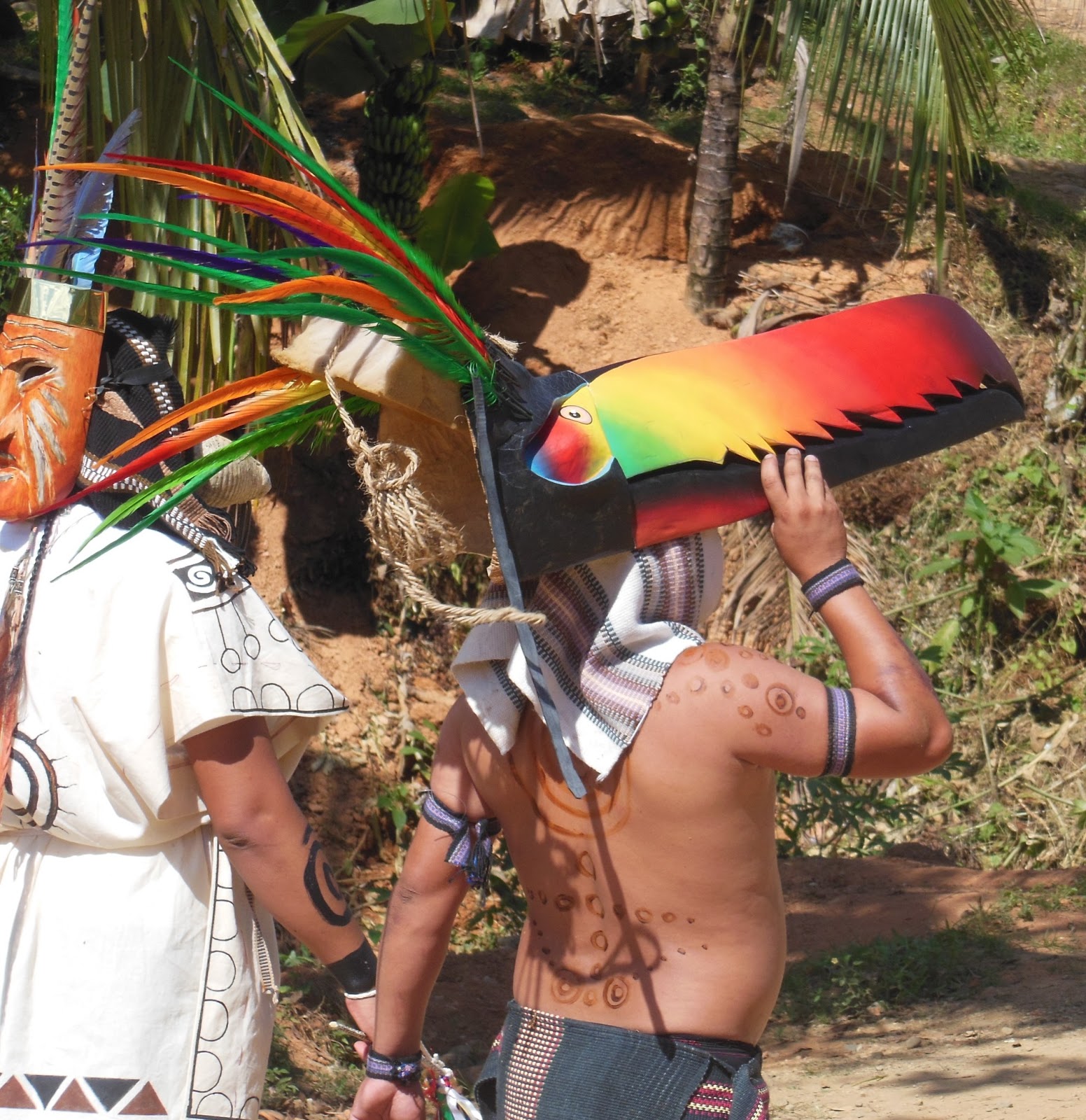
Once there, the diablitos commence parading the town stopping at every house to drink chicha (fermented corn liquor) and eat tamales. The diablitos wear intricate hand-carved and painted balsa wood masks and burlap sacks covered with jute and banana leaves. The procession is marked by the relentless collisions against a bull – a few of the men take turns carrying a heavy costume and bashing the diablitos– which represents the Spaniards.
The name ‘diablitos’, the horned masks, and the fighting symbolize the shrewdness, guile, courage and ardor that served them so well in resisting invading forces, while the sharing of drinks and food is indicative of their undeniable hospitality, not only among themselves, but with the few tourists who venture into the town to witness this astonishing display.

The masks are the main attraction and source of income throughout the year, when the diablitos drop their costumes and work in the fields, in San Jose or manufacturing masks and totems. However, during the festivity, it’s the evolving interaction with the bull that draws the most attention, as the diablitos, increasingly inebriated and aggressive, rampantly quarrel with the 40kg structure of the bull.
Adding to the uniquely vibrant imagery of Boruca during these dates, each diablito proudly and carefully carves and paints his own mask with colorful feathers, dramatic images of trees, flowers, animals and of course, hostile, menacing horns. Each mask is exclusively ornate, especially during the pinnacle of the feast, on January 2nd, when approximately 100 locals dress up and taunt the bull until it eventually gains ground and takes down all the diablitos. 

Then, the bull runs away, but the diablitos, inspired by the animal spirits that aided them centuries ago, rise from the dead, hunt down the bull and toss it into a blistering fire as they soar around the flames celebrating the victory. The revelry that ensues is even more exhilarating than in the previous nights, as the citizens of Boruca put on their best outfits and party well into the night.

So far we’ve had the chance to meet members of three different indigenous groups, while visiting two reserves. Despite being branded with the name ‘indigenous’, each of these groups is very different from the others, not only regarding cultural characteristics such as language, art and organization of society, but also with respect to progress and development – where they find themselves at this moment in history. 

Their openness to the world outside their barriers, their knowledge of world events, acceptance of tourism and external influences, as well as other aspects beyond their endemic culture are shaping their societies in ways undeterminably good or bad. Time will be the judge.

These groups continue to be called indigenous but the meaning and usage of this word has loosely dissipated in modern times. The Merriam-Webster dictionary defines indigenous as “having originated in and being produced, growing, or living naturally in a particular region or environment”.  
As for ‘indigenous peoples’, there is no universally accepted definition, but according to Wikipedia, there are three elements used to describe the term: the voluntary perpetuation of cultural distinctiveness, an experience of subjugation, marginalization and dispossession, and self-identification. However, according to these two definitions, most of the world’s population is indigenous. Surely, there must be something more to the essence of the word.

Colloquially, ‘indigenous’ is used to describe a close relationship with nature, respect for all things living, separation from the modern urban society, and the upholding of ancient traditions as core community values. Through the experiences of the last few months we have come to the realization that perhaps ‘indigenous’ is no longer a term to define a place of origin, but rather a way of living, a philosophy and a sentiment.

The indigenous people of Boruca, as well as many others throughout the world are in danger of extinction. ‘Being indigenous’ is not passed on genetically. It requires education, reason, sacrifice and determination.

Thus, the inhabitants of Boruca will continue to be called indigenous because they live in the land that their ancestors fought and cared for, and have the physical traits of their parents; but must of them won’t be indigenous in regards to the colloquial understanding of the word – unless they consciously choose so.

‘Being indigenous’ is not about being different, about suffering from marginalization and racism, but about preserving the unique and valuable elements of their ancestry. We’ve met many ‘indigenous people’ who do not enjoy a traditional way of living, or who do not respect nature, just as there are many ‘non-indigenous people’ throughout the world who share the indigenous philosophy.

Progress will come not through imposing or opening the doors to the modern world, but by building a bridge through which education, information and respect can travel both ways.


Tuesday, December 25, 2012

Puerto Viejo

It's unequivocal by now that we are tracing the footprints of Lady Luck. However capricious a mistress she might be, her love affair with our journey blooms splendidly in our favor. We must not grow arrogant though, for fortune is perfidious, and of many lovers. So, we walk cautiously, aware and informed, but intrepidly, for, after all, fortune favors the brave.

Although we relished the unexpected opportunity to visit Cahuita, we started to grow restless after a breezy week of idle strolls. We had nowhere to go until Tuesday the 11th of December - commencement date of our assignment with Planet Conservation in San Isidro del General. Thus, we woke up early on an unusually bright morning, decided to follow the trail of traditional tourism and headed south towards Puerto Viejo. Our main intention was to spend a placid day at the beach, for, despite all the attractions and entertaining possibilities, our budget had already suffered enough from the inflated touristic prices. Also, we wanted to find a hostel whose name we didn't remember, and whose owners we didn't personally know.

A few months ago, when we first made public our plans of embarking on our current voyage, Michael Pepple, a dear friend of ours, put us in contact with David Sloan and Danielle Kravetz, the owners of La Ruka, a friendly and accommodating lodge near Cocles beach, in the vicinity of Puerto Viejo. Regrettably, by the time we arrived in the unbridled, colorful enclave of Puerto Viejo, we had forgotten the name of the hostel, and had the wrong phone number.  After a few futile attempts at asking for directions to hostel 'La Amistad' or 'La Alegria', I, stifled by the heat, gave up.
However, Julia, persistent as ever, amicably approached a store to inquire "one last time, otherwise we'll go to the beach." The shopkeeper, another Spaniard far from home, cordially invited us to use his computer to investigate further, as he, despite publishing a monthly local magazine, had never heard of the made up hostels which we were naming.


With the correct name but no directions, we continued our unguided walk to the beach. Then, as if it had magically appeared out of the jungle, we saw it: La Ruka. Dave and Danielle have recently acquired the locale from its cynical past owner, and now live there with Dave's brothers, who work as members of the friendly staff. La Ruka is the quintessence of its proud owners who, through love and dedication have created a home for themselves, and anyone who wishes it to be. Easily appreciated at first glance, the hostel is a harmonious assemblage of jubilation, relaxation and camaraderie.

Dave and Danielle were amusingly baffled with our sudden appearance. Following a brief introduction, they offered us a pair of dowdy bikes and sent us on our way to Manzanillo, a remote village where the streets end and paradise begins.

The easternmost spot in Costa Rica, Manzanillo is an appetizer of the gaudy wildlife that extends behind its kilometric beach. Lined with coconut trees, soothing waves and wooden dories, Playa Manzanillo ends gently as the Gandoca-Manzanillo Wildlife Reserve begins. There, the prolific jungle is adamant to the frequent onslaught of the indomitable waves, who repeatedly smash against reef and rock, creating an instant raw spectacle for those who venture into the hidden treasures of fine sand. As one roams the hills outlining the coast, the serpentine roots of the corpulent, propitious trees serve as natural steps. Occasionally we would hear a vociferous troop of howler monkeys, but, despite its famed reputation as an animal sanctuary, we didn't see any animals, marine or terrestrial. Nonetheless, the breathtaking views were worth the bike ride.

Upon our return to La Ruka, we learned that we missed out on the best part of the reserve, for we didn't reach the end of the path. Exploring without a local guide has its negative consequences, but we were able to admire the mystic scenery by ourselves. Since Dani and Dave had been too busy to spend the day with us, we decided to meet in Cahuita the next day. After a peaceful morning exchanging stories and experiences at the beach, they invited us back to Puerto Viejo for the night to celebrate the life of a dog. Earlier that morning, the owner of the Tasty Waves Cantina - a close friend of Dani and Dave - had lost his lovable pet: a droll, adventurous dog appropriately named Nacho Borracho. A party unlike any others; somehow both tender and wild, it was a great occasion for us to discover just why they call Puerto Viejo "Costa Rica´s Miami." Music and exultance swarm the electric streets as the mingling, exuberant crowd of tourists and locals lavishly partakes in carefree celebrations.

The next morning, enchanted by the jaunty atmosphere of Puerto Viejo, and by the comfort of  real beds, we decided to stay one more day. Dani and Dave, incredibly generous and considerate, didn't hesitate to invite us again to spend the night at La Ruka, even offering us surf boards, bikes or scuba equipment to liven up yet another lovely day. We tried our luck with surfing, but the gnarly waves furiously hurled us around before we even attempted to swim beyond their breaking point.

Eventually, our fleeting visit to the Caribbean had to end. After two idyllic, gratifying nights in Puerto Viejo, we said goodbye to La Ruka and its endearing owners and returned to Cahuita. The next morning, we woke up early and sat out on the main road hoping to catch a ride, all the way to San Jose, where we had to find a bus that would take us to San Isidro del General.

After 45 minutes of potential cars bypassing our friendly sign, Julia stood up and determinedly announced: "the second car to appear is our ride". Astonishingly, the second car did pull over! The driver was another Spaniard, Juanca. The three of us enjoyed the road trip to San Jose, remembering our home country and cheerfully sharing our experiences in Costa Rica. After a long day of traveling, we stepped off the bus and were met by Federico Solorzano and Rafa Quesada, our colleagues and hosts in San Isidro del General. But that, our dear readers, is a whole 'nother story...


Saturday, December 1, 2012

Jishtiä ba shkina: Cabecar Culture and Landscape

Deep in the jungle, where the imposing Cordillera Central begins its steep bow to the flatlands, the Cabecar community of Palmera live sheltered by the effervescent Zent river. From there, a sea of plantations distance the indians from the susceptible waters of the Caribbean, painting a never ending horizon melted between the clouds and the murky tree tops.
Two hours uphill from the river a bastion between two cultures struggling to coexist an exceptional family shared their home, lifestyle and affection with us for a month and a half. Their insatiable curiosity, motivation and courage made our stay a blissful and uniquely memorable experience.

There, only the patios are cleared for the commodity of the inhabitants. Every other inch of land is cloaked with an uncontrollable curtain of green, which impetuously overflows into the prints of humankind. The diverse and lively rain forest is appalling; palm trees of every kind, centenary giants, covered with vines which sprout from everywhere and climb the massive columns of red, white and green bark. Also, fleeting specs of colorful birds, frogs and flowery ornaments adorn the evergreen sight. Fortuitously, toucans, parrots, lovebirds and smaller melodies in motion would visit the line of trees around the house, thus announcing a halt to the incessant rain.

For the first three weeks, the sun burned our skin, sharply, as if through a magnifying glass. The rain, backstage, awaited its opportunity to shine - or rather, dim - briefly appearing to freshen the air and feed the soil. At night, the moon was a mirror image of the sun, projecting all of its might. It shone so bright that shadows grew from our feet as we marvelled at the infinite spectacle of the milky way.
The masonry of the Cabecar women is dictated by the lunar periods. Only during the three days before and after the full moon can they begin the formidable labour of collecting mastate; the source of the material from which all of their clothes were made in past times. For many years, the mastate tree went unused, as the ancient knowledge of the craft had been forgotten. However, recently, the women rediscovered the skill thanks to an elder (our host´s father), who had retained the knowledge. But now that their clothes are products of a foreign culture, the material is used to make art instead.
Although the women sell these art pieces, the local economy is not impacted by these products, as they haven´t yet reached their full market potential. As of now, they only receive symbolic amounts from the few tourists who approach the secluded area or from good willing acquaintances of the Humanitarian Foundation, who serve as intermediaries and sell the art themselves.
Most of the men work strenuously in the banana and palm oil plantations on the edge of the reserve, while the women take care of their small crops and farm animals. Moreover, the women spend countless hours cooking meals over wood and fire, waking up as early as three in the morning to have breakfast ready by six. Children and teenagers, as well as some inquisitive mothers, attend school a decade-long concept for them. Speaking of motherhood, grandmothers who haven´t reached thirty years of age may be shocking to most of us, but to them it´s an ordinary occurrence. Judging by their intricate and confusing genealogy, their family trees must look like a map of the Madrid subway system.
Upon our arrival, we had a romantic vision of archaic indians, alienated from the far reaching hand of globalization, but confused as they observe how modernity attacks their identities and impedes their way of life. We have found a timid community, but one that is aware of the events happening far beyond their land. Sadly, they absorb the new culture faster than they are able to preserve their own. 

The fear and preoccupation for the loss of identity and culture is notable among the adults, and some of the youth. However, greed, comfort and a hint of innocent ignorance have submerged them into the convenience and amenity of the modern world. They are years past the traditional indigenous group that we erroneously imagined, but they still have a grip, however fragile, on the values and traditions that have persisted through history. The main channel through which this inheritance has travelled down the generations is the language. Cabecar is one of the four indigenous languages that are still active in Costa Rica, but marginalization leads many to reject their mother tongue and their roots altogether.
Life among the Cabecars is simple and quiet, but laborious. One does not need much, nor is there much to have, as humans do not own; nature does. The only possessions are their zinc roofed homes ‒ scattered around the mountain, it can take three hours to visit certain neighbors and the bare necessities; bought at a supermarket across the river. Everything else is taken from the mountain respectfully, previously asking for permission in order to avoid the lethal bite of the terciopelo (bothrops asper) snake.
Silence is constant, peaceful and harmonious. It is only interrupted by animals, rain and laughter the lighthearted reaction to problems. Silence, often mistaken by outsiders as stupidity, is a means of communication. However, it is much more than that, it is a protecting veil under which their affluent spirituality and philosophy has survived against the currents of imposing civilizations. 
It is our hope that this sensational culture finds a way to avoid fading into the quickly rising tide of capitalism and evolves to maintain its own traditions while absorbing the benefits of technology and modern life.


Tuesday, October 16, 2012

Departure

“I learned this, at least, by my experiment: that if one advances confidently in the direction of his dreams, and endeavors to live the life which he has imagined, he will meet with a success unexpected in common hours.”  - Henry David Thoreau, Walden, or Life in the Woods

It's hard to believe we have but two days until our departure. We've both been dreaming of that day for years, ruminating on the idea in our separate consciousness for much of our lives. Of course, and I speak for myself now, I was never sure what that day would bring, what the opportunity, prompt for seizing, would entail, or who would accompany me.

Close to a year ago, a fateful meeting between passion, fear and uncertainty injected a boiling shot of courage into our blood, giving way to an expression of love. Love for life, for justice; and for adventure, discovery. Love for a shared belief. Belief in the ideals quickly losing meaning in the parade of content and effortless philanthropy of the privileged. Of course, love and belief would need sacrifice in order to materialize, else they would fall into the deceit of feeling satisfied for having felt compassion, as if it made a difference. That we knew. Sacrifice is what separates ideals from action, dreams from reality.

Until recently, it has all seemed unreal. Borrowed from a great adventure story, too epic to dare explain it for fear of ridicule, too distant to confess our full ambition. It is clear to me that without the help and support of those who believe in us, and the commitment of others who share our cause, it would all have remained unsubstantial.

A mere few nights away from consummating months of gambling with our futures and juggling dozens of plans and decisions, the proportions of our journey have sized down from exaltedly epic to achievable. The details are perhaps not punctual enough, at least not enough to guarantee the conviction that we would wish to see in our loved ones, and perhaps ourselves. Nonetheless, the dream is lifted, and carried by the strength of our curiosity, youth and determination. Simultaneously, fear and uncertainty unwillingly yield to our desire to change ourselves and to discover another side of this world, with the prospect that, as Gandhi promised, "the tendencies in the world would also change".

At this moment, and perhaps not for many years after today, I cannot imagine the limitations of this adventure. I cannot predict how far our feet will take us, nor can I conceive what it might take to stop them. That is indeed an uncomfortable thought. Despite our vision and careful schemes, we cannot ever be the true masters of our future. However, I do believe that we have full governance of our present choices, and that is a very appeasing sentiment.