After six months of unanswered emails, worrying lack of news and uncertainty, we had admittedly began losing hope regarding any positive results from our work in Palmera, our first project of this trip. We had sent countless emails to the Costa Rican Humanitarian Foundation asking for news from the Cabecar Indigenous Reserve, and for the report we had written for them, so we could perhaps attract investment, tourism and volunteers to continue the process that the Foundation had started and we had enhanced during our nearly two months living with a local family. We had found a magnificent community, rich in resources and culture, but lacking in infrastructure. A very promising land where a terribly apathetic mindset obscured the vision of the future for the youth, despite their eagerness and commitment to education.
It was exactly with education, the bridge between preserving their ancestral history and bringing positive development to the community, where the key to the gate of the future lay for Palmera and the majority of its inhabitants. Although we focused our activities on strengthening the link between these two factors and improving local understanding of their importance, we hit a massive road block very early in the form of corruption.
The newly appointed principal of the high school had taken advantage of the seeds planted by his predecessor, now working a few hundred meters away as principal of the elementary school, and didn't take long to harvest the rewards. There was factual evidence that he was repeatedly using school funds for personal use, buying personal hygiene products, food and alcohol, as well as rather heavy accusations of drug use on school grounds and in the presence of students. In addition, the president of the board of education, otherwise known as the town drunk, had taken a liking to the methods of the new principal and soon became involved in these insidious activities. The most worrying result of these acts was the constant cancellation of classes, three or four times a week for lack of food in the school cafeteria, and the inability of the faculty to buy teaching materials. Teachers had to use their own money for such purchases.
The students displayed a flagrant mistrust in the educational system as was demonstrated by the lacklustre attendance, which was well under fifty percent. Many of the young boys would rather work with their fathers in the nearby plantations. The girls, many of whom were already mothers, could not afford to waste their precious time at a school that didn't provide a meal nor an education, and preferred to tend their domestic duties, as Cabecar tradition dictates.
Infuriated upon realizing this, and urged on by members of the community, teachers and students, we wrote a letter to the regional authorities and the local board of education, asking for an internal investigation, a new directive and a series of conditions in order to achieve transparency and a more efficient administration in the years to come.
The effects of the letter were immediate, although not as impactful as we had hoped. As news of a board meeting to assess the situation spread through the town, fierce tension invaded the faculty, the student body and the general population, as everyone began dividing between those who supported the principal and those who quietly disapproved. Fortunately, there was a third group: those who had taken a stand against the principal and the president of the board. Unfortunately, the group only consisted of our host family, the school cook, as the teachers who had initially inspired and incited us to take action, ultimately denied everything in fear of losing their jobs. The board meeting, which was dramatically similar to a court trial was hindered by the principal, who made sure it was scheduled during school hours so that the few students who were willing to take a stand against him would not attend. Much to our dismay, Leo, the father of our family forbid us from attending, fearing an angry reaction from the two characters involved, who had proven to be rather unpredictable.
As we had expected, without lack of support for our cause, the principal asserted his position at the board meeting, gaining support from the board members, whom he and the president had appointed. The appointees were illiterate, an unlawful situation, as we came to find out.
Our projects at the school became severely hampered on account of our actions, as we were no longer welcomed at the school. Some of the teachers were certainly reluctant to be seen speaking to us, so we spent most of our time with our family.
What had begun as an emotive and devoted campaign, ended quietly as we left Palmera without any visible results to our actions. Eventually, once we had the time and resources, we extended our letter to the Ministry of Education, but only received an acknowledgement of receipt from them. The past few months we had often wondered, albeit hopelessly, what had been of the situation in Palmera, and whether Leo, his family or anyone in town had fed the fire that we had ignited.
Surprisingly, yesterday we received a great piece of news from the Costa Rican Humanitarian Foundation.
The principal of the school has been sanctioned, and is being very carefully watched by the Ministry of Education. They are assessing the situation and may fire him in the coming weeks. From now on, the principal is not allowed to cancel classes, nor does he have access to funds, as it goes directly from the Ministry to the suppliers. The members of the board of education are now named democratically by the people and the student government has been given additional support and power. The people of Palmera are satisfied with these changes, which they directly attribute to the document we drafted in early November.
We left Palmera more than half a year ago, with an amazing experience to remember for the rest of our lives, but disappointed at being unable to make a lasting impact. Over the past few months, a mountain of disappointment had began to build on the foundations created during our time in Palmera as we poured our hearts and souls into several projects along the way but failed to see the end results. Thus, as you can imagine, it is extraordinarily rewarding and fulfilling to receive these news.
We can now see more clearly the importance of embroidering experiences, even the most marvelous ones, with actions which will last beyond memory.
"They are small things. They don't bring an end to poverty or lift us out of underdevelopment, they don't enforce social responsibility in means of production and exchange, and they don't expropriate Ali Baba's caves. But perhaps they set in motion the joy of doing, and translate it into specific acts. And, when all is said and done, acting on reality and changing it, although just a little bit, is the only way to prove that reality is transformable." - Eduardo Galeano (Uruguayan journalist and writer)
You can find the report we wrote to the Costa Rican Humanitarian Foundation and the letter to the Ministry of Education in our new 'Documents' section.
Showing posts with label Latin America. Show all posts
Showing posts with label Latin America. Show all posts
Tuesday, June 11, 2013

Wednesday, May 1, 2013
10 Simple Hitchhiking Tips
To go along with our last post, we have decided to write down a few tips for hitchhikers, which for us have become rules.
We hope this can be useful to those of you who decide to hit the road.
How long does it take to get there?
Know the roads.
Drivers are also scared of picking up strangers, so look polished and SMILE A LOT!
We hope this can be useful to those of you who decide to hit the road.
1. Be informed.
What is your final destination?How long does it take to get there?
Know the roads.
2. Plan your journey.
If you don't reach your destination in one day, have a backup plan to sleep in a safe place.3. Safety backups.
Make sure someone knows where you are.4. Quantity matters.
Two is the perfect number for hitchhiking. Being alone can be a
little risky, and not every car will have space for three people plus
luggage.
5. Don't hitchhike at night.
6. Placement matters.
Some believe that hitchhiking is best done in well populated areas, because more cars go by, and the amount of bystanders will somehow fend off any evil doers.
We believe the opposite. Hitchhiking is most effective in less traveled roads. We suspect people are more willing to pick up someone if they believe that person will have a tough time finding a ride. However, if a lot of cars drive by, most will discard the thought of picking a hitchhiker up by thinking "someone else will do it."
7. Don't get in cars with tinted windows.
8. Check the car for signs.
As soon as you get in, check for things like religious symbols, the
driver's clothing, baby seats or anything that might let you know what kind of person has picked you up. Also, the initial conversation is rather revealing.
9. Keep your belongings close and accounted for.
10. Look friendly, be friendly.
Be kind, thankful and well mannered, the people who pick you up will be more willing to pick up the next hitchhiker they see if their experience with you is enjoyable.Drivers are also scared of picking up strangers, so look polished and SMILE A LOT!
Saturday, April 20, 2013
San Isidro to David - A hitchhiking mission
On January 17th, the eve of our intended entrance into Panama - a country of transit, of separation and union, of thin contour but thick authority - we decided to avoid the easy yet expensive and uncomfortable bus ride through the mountainous section of the serpentine Interamerican Highway and the congested southern border crossing of Paso Canoas. Instead, we dove into the murky, unpredictable waters of hitchhiking. We were fully aware of the usual dangers associated with this alternative way of traveling, and wary of the particular risk of our undertaking, for we inescapably had to exit Costa Rica by the 19th, or else we would be forced to pay absurdly hefty fines.

We began the day as early as possible, in the fashion of what we now have began calling 'travel day', and after sharing a heartfelt 'see-you-later' with Esther, our neighbor, we set out to conquer the road. We erroneously thought that the best place to hitchhike would be the Interamerican Highway, for traffic is fluid and constant as it intersects San Isidro. After one hour of bypassing cars and trucks, whose drivers regarded us with distrust, disbelief, or mockery, we began to consider changing our spot and our route. Toute de suite, as we picked our bags up and headed to the other side of the city, a folksy local stopped a few meters down the road and offered us a ride 20 km out of the city. After a few minutes, our impromptu driver received a call urging him to return to San Isidro.
Perhaps more than any other incident that day, this opportune phone call would decisively alter the course of our hitchhiking adventure. This was an opportunity to frequent the coastal road. Our newest friend dropped us of in the western side of the city, where the road towards Playa Dominical begins. We learned that this path is preferred by those who descend towards Panama or the Costa Rican duty free paradise town of Golfito, as it is faster, straighter and more pleasant. In retrospect, it proved to be a good decision. Within a quarter of an hour we were in the back of a jeep with a couple of Jehova's Witnesses.
 Much like on a snowy peak, one's emotions while hitchhiking can abruptly change from a restful blanket of powder snow into a rummaging avalanche swiftly occupying every inch in its path. Every time a friendly face breaks our expectant and patient wait to bring us closer to our final destination, an exhilaration of intrigue, nervousness and relief rushes through us.
Elated, we collect our cluster of bags and dart towards the car, as if afraid that the driver will regret his decision and take off before we can reach it.
One must be careful though, for all the excitement can play tricks on anyone, even the most responsible travelers. When a car does stop before you, remember that you most probably wont coincide with that person again, so it is always a good idea to double check your belongings before stepping out. Common sense would dictate so. It is common knowledge that common sense is not that common, although perhaps neither is knowledge. In any case, 'common sense' is often forgotten in times of urgency. That is why we recommend to turn this practice into routine.
Needless to say, we acquired this piece of advice by learning from experience, after forgetting our cell phone in the back seat of the Witnesses' car. Thankfully, a nearby information center allowed us to call our phone, which we had remembered to charge the previous night (also an useful practice before 'travel day') and after a few attempts, they answered.

Fortunately, they hadn't gotten very far and, although a bit reluctant - understandably so - they committed to bringing it back to us. Between one thing and another, we had lost an hour of valuable time and potential rides, but we had all of our belongings and were once again ready to hit the road.
Little by little we advanced along the coastal road, including a ride which caught us right in the midst of preparing a pitiful but delicious road-side picnic. We were in no position to refuse a ride, but our half-made tuna and tomato sandwiches were not negotiable. So, we jumped into the car with the tuna half spread and the tomato half cut; juggling to stop them from dripping all over the backseat and eager to devour them.
After four kind drivers and ten hours on the road - on wheels as well as on the road's shoulder with our thumbs up - we suddenly found ourselves shelter-less, minutes from dusk, in one of those crooked, lawless towns born out of a junction, where good never stops and bad always returns. As darkness neared, we began to fear that our romance with the risk and intrigue of hitchhiking would result in rose petals on the ground. However, a desperately polite plea hurled to the swift passing of a car - one of many petitions lost in the dust and odor of the asphalt - met obliging ears. Not without prior conjugal resolution, Marcia and Andres, a couple with a turbulent past but kind and charitable disposition, turned the car around and offered us a ride to the border; and to their home.
 We spent the night comfortably on an inflatable mattress installed on the kitchen floor of their humble home, ten minutes from the border. Without asking for anything in exchange, they shared their food, time, faith and life stories with us.
Having spent the best part of their youth as victims of poverty, crime and pitiless romance, both had now found in religion and each other the strength and wisdom to overcome the cruel adversities of life; which in Marcia's case included several years in prison. Not for a second did we feel frightened or uncomfortable after this revealing confession. In fact, we felt lady luck's smile shining above us once again after having found a couple so inclined to help us in such a precarious circumstance. The following morning, they prepared our last Tico breakfast (which consists of re-cooked rice and beans) and accompanied us to the frontier, where we complied with the necessary paperwork, and within an hour had entered into our second country: Panama!
This time, we only had to wait fifteen minutes for Edgar, a young Panamanian who also resorted to hitchhiking in his travels, and thus, did not hesitate to pick us up. As if it were customary when picking up hitchhikers, Edgar also treated us to a meal. Nonetheless, a meal and a ride wasn't enough for Edgar. He also took us to buy a Sim card for our phone and dropped us off at the doorstep of our hostel! Lastly, before we parted ways thinking we would never see this kind-hearted man again, he offered to take us to visit the mountains and beaches surrounding David, where one can find the touristic attractions of western Panama, aside from the over exploited archipelago of Bocas del Toro.
 Incapable of wasting a chance to discover new places, just a few hours passed before we were in Edgar's car once again, heading to the famous mountain town of Boquete, a tourist favorite where an international coffee and flower festival was taking place. We spent a wonderful day in the mountains, but bypassed the festival, for it was an over hyped and overpriced magnet for easily impressed tourists and a reason for impoverished locals to spend their measly savings on alcohol. The mountains proved to be much more enticing, as we drove and walked through stunning cliffs, waterfalls and rivers. As we marveled at such a scenic contrast to the flat, dry, asphyxiating heat of David (just 40 minutes away) we discussed Panamanian politics and the ongoing power struggles between the implacable indigenous communities that reside in the mountains and the national government. The current government of Ricardo Martinelli has completely disregarded the autonomy of the Indigenous Comarcas (an Indian Reservation with the characteristic of a quasi-autonomous province) and unrelentingly sought to cash in on their untapped resources by granting construction permits to multinationals so they can build hydroelectric plants, mines and power lines to feed the increasing demand for resources and electricity in Panama City and Costa Rica.
Ironically, despite Edgar's antindustrialist comments and his advocation for traditional agriculture, sustainable development methods and the preservation of indigenous communities and the environment, he works at a hydroelectric plant; the main symbol of foreign industrial imposition, of economic disparity and rural underdevelopment in Panama. At first we were reluctant to hint at the hypocrisy of his words, but after a few more rendezvous we gained enough trust to engage in a conversation about the friction between ideals and reality, thought and action. He explained that in Panama the options for electromechanical engineers are few and limited, and that he had spent a great deal of time and money in university to end up working in low-income, low-satisfaction jobs. While we understood the desire to challenge himself and reach his full potential, we couldn't help but to think that the high pay was more motivation than the excitement of hydroelectricity or the lack of other options. Nonetheless, there is always another way.

In David we stayed in a hostel called Purple House. As the name indicates, it is purple. The problem is that everything in the hostel is purple. The walls, chairs, plates, cups, blankets, furniture, decorations, doors, soap. Everything. Is. Purple. It's surprising that the owner - a serious, almost rude lady with a good heart and the need to please every client that steps in her hostel - isn't purple, or at least crazy. After a couple of days I began to feel a bit claustrophobic, or rather, porphyrophobic and was itching to move on to our next project and less monochromatic surroundings.
Thankfully, after three nights of interesting yet speculative conversations - a dogma of the backpacker - we finally managed to escape our halt and found our next destination: Soloy.
Although we didn't learn anything new about the secrets of human goodness and generosity, this experience allowed us to meet people of various backgrounds and unconditional generosity. In any case, we did ascertain that hitchhiking is not an outdated or extremely risky way to travel. Of course, this isn't true in every country, but if you employ routine caution, there is no reason to fear the worst and all the reasons to enjoy an alternative way to travel and meet people.

Thursday, January 10, 2013
Boruca - New Year with the Devils

On the last day of 2012 we boarded yet another bus in our long list of ill-fitting buses and headed to Boruca, the main settlement within the Boruca Indigenous Reserve. Do not be
mislead by the use of ill-fitting, for, despite their leisurely pace, the
quality of the buses is more than sufficient. The problem at hand is that the
seats are designed bearing in mind the average height of Costa Ricans, which,
for men, is nearly 20 cm less than the stature of yours truly. As you can
imagine, negotiating bumpy roads with barely a few inches of meager legroom and
a vacuum behind your head which lets your neck wobble like a boxing ball is not
a pleasant experience.
 After a two hour journey
during which we constantly had to ask our neighbors where we had to get off, the
driver informed us that we had reached the entrance to Boruca. Unbeknownst to
us, we were twelve kilometers of devastatingly steep, arid dirt away from the
actual town.
After a two hour journey
during which we constantly had to ask our neighbors where we had to get off, the
driver informed us that we had reached the entrance to Boruca. Unbeknownst to
us, we were twelve kilometers of devastatingly steep, arid dirt away from the
actual town. In hindsight, we regarded
the sheer path ahead of us and the gleaming noon sun with too much disdain. We nearly
paid for our foolishness and disrespect when, after half an hour, unable to
find a shade to rest, we began questioning if we had made the right decision.
Luckily, a kind family coerced us into riding in the back of their pick-up
truck and turned what would have been a painstaking five hour hike into a 30
minute rollercoaster ride through the jarring unpaved hills.
In hindsight, we regarded
the sheer path ahead of us and the gleaming noon sun with too much disdain. We nearly
paid for our foolishness and disrespect when, after half an hour, unable to
find a shade to rest, we began questioning if we had made the right decision.
Luckily, a kind family coerced us into riding in the back of their pick-up
truck and turned what would have been a painstaking five hour hike into a 30
minute rollercoaster ride through the jarring unpaved hills.
Once in the town, we
installed our camping tent and proceeded to discover what the town had to
offer, including a majestic waterfall and an ancient blend of dancing and
bull-fighting.

 Submerged in the Talamanca
Mountains and encircled by the scenic valley of the Rio Grande de Terraba, this
secluded site was once part of a vast territory. Before the arrival of the Spanish Empire in the 16th century, the Coto, Turruca, Borucac, Quepos and the Abubaes feuded over the region of the Pacific coast of Costa Rica, from present day Quepos to the frontier with Panama. Today, the Boruca are a composite group of nearly 2500 people, formed by the descendants of the dispersed tribes, who are said to have survived the invasion thanks to the aid of natural spirits.
Submerged in the Talamanca
Mountains and encircled by the scenic valley of the Rio Grande de Terraba, this
secluded site was once part of a vast territory. Before the arrival of the Spanish Empire in the 16th century, the Coto, Turruca, Borucac, Quepos and the Abubaes feuded over the region of the Pacific coast of Costa Rica, from present day Quepos to the frontier with Panama. Today, the Boruca are a composite group of nearly 2500 people, formed by the descendants of the dispersed tribes, who are said to have survived the invasion thanks to the aid of natural spirits. Despite crowning a
captivating mountain range and proudly boasting a phenomenally picturesque
cultural tradition, Boruca is dreadfully indistinct from any ordinary Costa
Rican town. Granted, this characteristic has positive and negative aspects.
Despite crowning a
captivating mountain range and proudly boasting a phenomenally picturesque
cultural tradition, Boruca is dreadfully indistinct from any ordinary Costa
Rican town. Granted, this characteristic has positive and negative aspects. 
The first indigenous reserve to receive
government aide, Boruca has been endowed with electricity, well equipped
schools and a centralized structure for a quarter century. The view, otherwise rural
and organic; adorned with banana-leaf-roofed ranchos, is abhorrently obstructed with cables, a massive cross,
satellite dishes and a devastating amount of garbage.
Tourists, often deceived
into visiting insipid cultural sites, may consider the town fairly
unexceptional if they visit during any other time of the year. But, peculiarly coinciding
with the end of the Christian year, from the evening of December 30th
until the twilight of January 2nd, the Borucas celebrate the Fiesta de los Diablitos (Festival of the
Little Devils) in commemoration of their survival against the forces of Spanish
conquistadors. This ritual with a side of party and a pinch of brawl is
anything but dull. The festivity is a flaming showcase of their culture and
spirit.
 Minutes before midnight
on December 30th, the town’s elder summons all the diablitos – basically any male over 15
years old – to his house.
Minutes before midnight
on December 30th, the town’s elder summons all the diablitos – basically any male over 15
years old – to his house.
Once there, the diablitos commence parading the town
stopping at every house to drink chicha
(fermented corn liquor) and eat tamales.
The diablitos wear intricate hand-carved and painted balsa wood masks and
burlap sacks covered with jute and banana leaves. The procession is marked by
the relentless collisions against a bull – a few of the men take turns carrying
a heavy costume and bashing the diablitos– which represents the Spaniards.
The name ‘diablitos’, the
horned masks, and the fighting symbolize the shrewdness, guile, courage and
ardor that served them so well in resisting invading forces, while the sharing
of drinks and food is indicative of their undeniable hospitality, not only among
themselves, but with the few tourists who venture into the town to witness this
astonishing display.
The masks are the main
attraction and source of income throughout the year, when the diablitos drop
their costumes and work in the fields, in San Jose or manufacturing masks and
totems. However, during the festivity, it’s the evolving interaction with the
bull that draws the most attention, as the diablitos, increasingly inebriated
and aggressive, rampantly quarrel with the 40kg structure of the bull.
Adding to the uniquely
vibrant imagery of Boruca during these dates, each diablito proudly and
carefully carves and paints his own mask with colorful feathers, dramatic images of trees, flowers, animals
and of course, hostile, menacing horns. Each mask is exclusively
ornate, especially during the pinnacle of the feast, on January 2nd,
when approximately 100 locals dress up and taunt the bull until it eventually
gains ground and takes down all the diablitos.

Then, the bull runs away, but
the diablitos, inspired by the animal spirits that aided them centuries ago,
rise from the dead, hunt down the bull and toss it into a blistering fire as
they soar around the flames celebrating the victory. The revelry that ensues is
even more exhilarating than in the previous nights, as the citizens of Boruca
put on their best outfits and party well into the night.
 So far we’ve had the
chance to meet members of three different indigenous groups, while visiting two
reserves. Despite being branded with the name ‘indigenous’, each of these
groups is very different from the others, not only regarding cultural characteristics
such as language, art and organization of society, but also with respect to
progress and development – where they find themselves at this moment in
history.
So far we’ve had the
chance to meet members of three different indigenous groups, while visiting two
reserves. Despite being branded with the name ‘indigenous’, each of these
groups is very different from the others, not only regarding cultural characteristics
such as language, art and organization of society, but also with respect to
progress and development – where they find themselves at this moment in
history.  Their openness to the world outside their barriers, their knowledge of
world events, acceptance of tourism and external influences, as well as other
aspects beyond their endemic culture are shaping their societies in ways undeterminably
good or bad. Time will be the judge.
Their openness to the world outside their barriers, their knowledge of
world events, acceptance of tourism and external influences, as well as other
aspects beyond their endemic culture are shaping their societies in ways undeterminably
good or bad. Time will be the judge. These groups continue to
be called indigenous but the meaning and usage of this word has loosely
dissipated in modern times. The Merriam-Webster dictionary defines indigenous
as “having originated in and being produced, growing, or living naturally in a
particular region or environment”.
These groups continue to
be called indigenous but the meaning and usage of this word has loosely
dissipated in modern times. The Merriam-Webster dictionary defines indigenous
as “having originated in and being produced, growing, or living naturally in a
particular region or environment”.  As
for ‘indigenous peoples’, there is no universally accepted definition, but according
to Wikipedia, there are three elements used to describe the term: the voluntary
perpetuation of cultural distinctiveness, an experience of subjugation, marginalization
and dispossession, and self-identification. However, according to these two
definitions, most of the world’s population is indigenous. Surely, there
must be something more to the essence of the word.
As
for ‘indigenous peoples’, there is no universally accepted definition, but according
to Wikipedia, there are three elements used to describe the term: the voluntary
perpetuation of cultural distinctiveness, an experience of subjugation, marginalization
and dispossession, and self-identification. However, according to these two
definitions, most of the world’s population is indigenous. Surely, there
must be something more to the essence of the word. Colloquially, ‘indigenous’
is used to describe a close relationship with nature, respect for all things
living, separation from the modern urban society, and the upholding of ancient
traditions as core community values. Through the experiences of the last few
months we have come to the realization that perhaps ‘indigenous’ is no longer a
term to define a place of origin, but rather a way of living, a philosophy and
a sentiment.
Colloquially, ‘indigenous’
is used to describe a close relationship with nature, respect for all things
living, separation from the modern urban society, and the upholding of ancient
traditions as core community values. Through the experiences of the last few
months we have come to the realization that perhaps ‘indigenous’ is no longer a
term to define a place of origin, but rather a way of living, a philosophy and
a sentiment.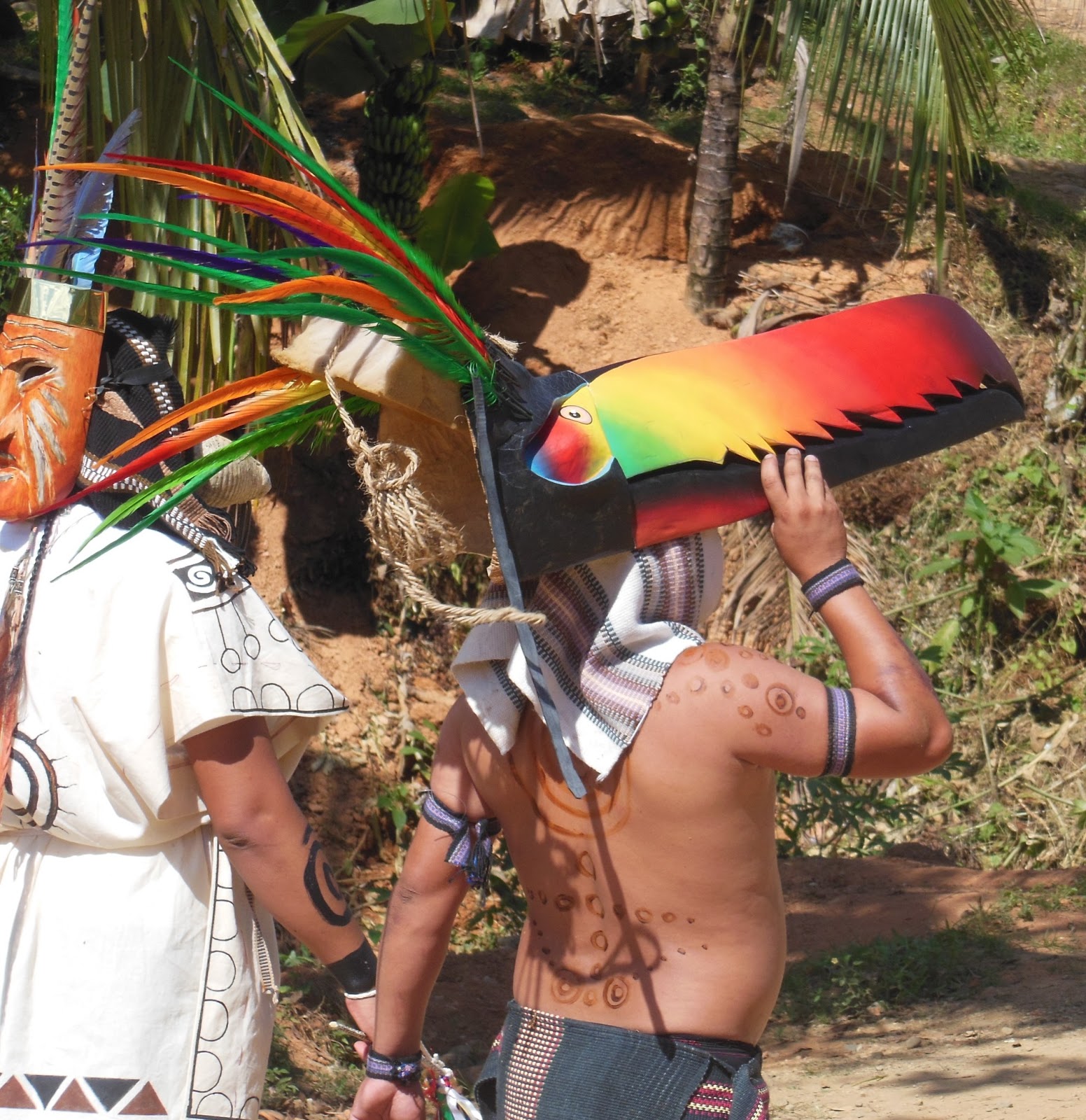 The indigenous people of Boruca, as well as many others throughout the world are in danger of extinction. ‘Being indigenous’ is not passed on genetically. It requires education, reason, sacrifice and determination.
 Thus, the inhabitants of Boruca will continue to be called indigenous because they live in the land that their ancestors fought and cared for, and have the physical traits of their parents; but must of them won’t be indigenous in regards to the colloquial understanding of the word – unless they consciously choose so.
 ‘Being indigenous’ is not about being different, about suffering from marginalization and racism, but about preserving the unique and valuable elements of their ancestry. We’ve met many ‘indigenous people’ who do not enjoy a traditional way of living, or who do not respect nature, just as there are many ‘non-indigenous people’ throughout the world who share the indigenous philosophy.
Progress will come not through imposing or opening the doors to the modern world, but by building a bridge through which education, information and respect can travel both ways.

Monday, December 31, 2012
Infiltrated volunteers: Matapalo
It’s remarkably inspiring to witness the
amount of people who gladly sacrifice their time, and often
money, to become part of a cause much larger than themselves. Since arriving in
San Isidro in early December, we have had the chance to meet and work with
several volunteers. Whether they are committing their efforts entirely selflessly
or as a way to expand their knowledge on a specific subject, the result is undeniably
constructive.
Volunteering is able to decrease the
disparities in society, such as poverty, segregation and exclusion. The pillars
of volunteerism; solidarity and commitment are comforting constants upon which
we can rely as the driving force for the crucial adjustments we must make to
our way of living; both as individuals and as a society. The principles of
volunteerism are remarkably pertinent in increasing the competence of those
exposed, vulnerable and weak so they can attain a safe and sustainable living
situation as well as to improve their physical, financial, spiritual and social
well-being.
 Although by many standards we are
considered volunteers, we have decided to create a different term for our
specific situation to be able to differentiate ourselves from the many charitable
people we have crossed during our work at Planet Conservation. We have recently
begun calling ourselves “freelance volunteers”. By no means do we intend to emphasize
our work with this differentiation. In fact, our work lacks any real, or
quantitative, value until we finish the journey and are able to produce substantial
and defined conclusions, while ‘regular’ volunteering yields direct results.
Although by many standards we are
considered volunteers, we have decided to create a different term for our
specific situation to be able to differentiate ourselves from the many charitable
people we have crossed during our work at Planet Conservation. We have recently
begun calling ourselves “freelance volunteers”. By no means do we intend to emphasize
our work with this differentiation. In fact, our work lacks any real, or
quantitative, value until we finish the journey and are able to produce substantial
and defined conclusions, while ‘regular’ volunteering yields direct results.
 Although by many standards we are
considered volunteers, we have decided to create a different term for our
specific situation to be able to differentiate ourselves from the many charitable
people we have crossed during our work at Planet Conservation. We have recently
begun calling ourselves “freelance volunteers”. By no means do we intend to emphasize
our work with this differentiation. In fact, our work lacks any real, or
quantitative, value until we finish the journey and are able to produce substantial
and defined conclusions, while ‘regular’ volunteering yields direct results.
Although by many standards we are
considered volunteers, we have decided to create a different term for our
specific situation to be able to differentiate ourselves from the many charitable
people we have crossed during our work at Planet Conservation. We have recently
begun calling ourselves “freelance volunteers”. By no means do we intend to emphasize
our work with this differentiation. In fact, our work lacks any real, or
quantitative, value until we finish the journey and are able to produce substantial
and defined conclusions, while ‘regular’ volunteering yields direct results.
In fact, we began calling ourselves this
rather pompous name when we attempted to explain the type of work we have been
doing and not many people seemed to understand that we have traveled here on
our own account. While we have the most sincere respect for genuine eco-volunteering
and ‘voluntourism’, we are not in the business of paying to do work. Our trip
has different goals.

We do not intend to limit our work to
foundations, NGOs, or government projects. It has been repeatedly but
appropriately recognized that small acts can have a huge impact. Groups of
organized neighbors, families and even individuals can immensely influence
other people’s lives, communities and the habitat that surrounds them. These
actions, born out of altruism are perhaps more effective than those of massive, institutionalized, bureaucratic organizations.
After only one week of living in San
Isidro we got to discover just how powerful a relatively small act can become.
Not only in the purpose of the act itself, but in the economic and moral
improvement of a whole community.

Moved by what she considered a problem of
utmost significance, she convinced her family to build a makeshift hatchery in
their backyard. Judiciously, they would patrol the beach at night in search of nesting
mothers. As the turtles placidly descended towards the ocean after finishing
the phenomenal, yet arduous task of laying eggs, they would run in and
carefully excavate the camouflaged pits and take the eggs to the hatchery,
where they could shelter the hundreds of unborn hatchlings from menacing predators.

Our placement at Planet Conservation was
opportune enough that we were able to spend a weekend visiting the project
before turtle season ended. The motive for deploying us at the Matapalo Project
was to examine and analyze how a turtle conservation program operates. For
three days, we lived and worked as regular volunteers in the ASVO house. We
were ecstatic about the prospect of witnessing a turtle (although not an arribada, a communal arrival of hundreds
of turtles for a few nights) or perhaps the birth of a nest; but our chances
were faint, given that the season was practically over. Our main hope resided
on the mere eight nests that remained in the hatchery.

It was too much to ask to see a turtle, but we did enjoy the serenity of
walking through a misty beach depending only on the stars and a couple of
fishing boats for illumination. Patrolling is only one of the many duties of
the volunteers and staff. Depending on the month, various teams ranging from
one to three people keep their eyes peeled as they march through the sand
retrieving nests.

On Saturday, our second day at the
project, we participated in cleaning duties, played a rough football match on the beach and celebrated an early Christmas with the staff and volunteers, who joined hands to cook a lavish feast of local dishes. In the afternoon, we visited the edge of a natural park; where a river, a beach and a forest have created a peaceful sanctuary.
On our second and final night we were
appointed to guard the hatchery from midnight until four in the morning. Since
we didn’t want to miss the possible, but improbable birth of baby turtles, we
asked the volunteers taking the first shift to warn us in case of any hatchings.
To their surprise, they encountered a nest full of nervous hatchlings, zealously
waiting to flee for the open ocean.
 With
the fresh, luscious taste of passion fruit mousse lingering in our palates, we
eagerly bequeathed our unfinished plates and sprinted towards the hatchery.
With
the fresh, luscious taste of passion fruit mousse lingering in our palates, we
eagerly bequeathed our unfinished plates and sprinted towards the hatchery.
Methodically, but unable to conceal our
enthusiasm, we counted the 85 newborns and moved them to the beach in a large container.
Our hands were tremulous with excitement, as we set the bucket down six meters
from the water and carefully placed every single courageous little creature on
the sand. Once the last of the instinctive wanderlusters had departed, the
nervous giggle we had uttered throughout the process was suddenly amplified
into a triumphant, exuberant laughter to escort the turtles past the
breaking waves as it echoed in the dark.
We couldn’t help but compare our lives to
those of the valiant young turtles. The adorable, even jocular display is a
rather didactic event for us. Yet to taste the sweet tenderness of a mother’s
care, they must confront many of nature’s most bitter lessons. The friable pack
embarks without any deliberation on a quest towards a most unsure and ambiguous
objective; life. Granted, instinct, not reason, is the driving force of their
actions. But wouldn’t our lives be more valuable, and worth living if we devoted
them to do what we know to be right without fear of the obstacles that may stand in our
path?

Subscribe to:
Posts (Atom)